7GA Steel Thickness: Complete Guide to Steel and Stainless Steel Gauge
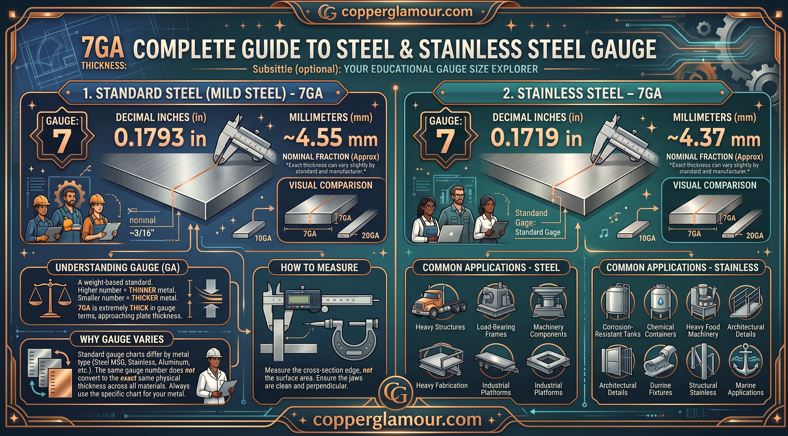
7GA steel thickness is approximately 0.1793 inches, or 4.55 mm, under the U.S. Manufacturers’ Standard Gauge for standard sheet steel. However, gauge measurements depend on the metal involved. Therefore, you should not automatically use a standard-steel gauge measurement for stainless steel, aluminum, galvanized steel, or wire.
This distinction matters when ordering materials for fabrication, construction, equipment, automotive projects, or home improvements. Moreover, understanding gauge helps you compare materials without assuming that a larger gauge number means thicker steel. In fact, traditional sheet-metal gauge systems generally work in the opposite direction.
Metal can also become an important design element in the home. Stainless steel creates a cool, modern finish, while copper adds warmer color and character. At Copper Glamour, shoppers can explore copper kitchenware, drinkware, serveware, jewelry, and decorative pieces that complement stainless and steel finishes.
What Is 7GA Steel Thickness?
Under a commonly used U.S. standard for sheet steel, 7GA steel thickness is:
0.1793 inches
4.554 mm
Therefore, you can generally think of 7-gauge standard sheet steel as being about 4.55 mm thick.
However, nominal thickness and the actual measured thickness of a finished sheet can differ slightly because manufacturing tolerances apply.
Consequently, fabrication projects that require precise dimensions should use the supplier’s technical specifications rather than relying exclusively on a general gauge conversion.
Is 7 Gauge Steel Thick?
Yes. Compared with many common sheet-metal gauges, 7 gauge represents relatively heavy material.
Remember that the gauge system generally works backward: as the gauge number decreases, thickness increases within the same applicable standard.
Therefore, 7-gauge standard steel is substantially thicker than 16-, 18-, or 20-gauge sheet steel.
That additional thickness can provide greater rigidity and resistance to deformation. However, it also increases weight and may require more substantial equipment for cutting, bending, drilling, and welding.
Why Steel Gauge Can Be Confusing
Gauge is not a direct unit of measurement.
For example, 7 gauge does not mean 7 millimeters. Likewise, 16 gauge does not mean 16 millimeters.
Instead, each gauge number corresponds to a nominal thickness under a particular system.
Furthermore, gauge-to-thickness values can vary according to material. Consequently, simply asking for “7-gauge metal” can leave important information unanswered.
A clearer technical specification would identify the material and its actual thickness.
For example:
Standard sheet steel, 7 gauge, approximately 0.1793 inches or 4.55 mm.
That description provides considerably more useful information.
How Stainless Steel Gauge Works
Stainless steel gauge follows the same general principle that lower gauge numbers indicate thicker sheet within the applicable system.
However, stainless steel and standard steel gauge conversions should not automatically be treated as identical.
Therefore, always use a material-specific chart.
The National Institute of Standards and Technology provides authoritative information about measurement science and standards in the United States. For technical fabrication, supplier specifications and the governing industry standard should also be checked.
Stainless Sheet Metal Gauge Explained
A stainless sheet metal gauge provides a shorthand way of describing sheet thickness.
For example, commonly encountered stainless sheet gauges include 22, 20, 18, 16, 14, 12, and 10 gauge.
As the number decreases, the sheet becomes progressively thicker within the same convention.
This relationship means:
22 gauge is thinner than 20 gauge.
20 gauge is thinner than 18 gauge.
18 gauge is thinner than 16 gauge.
16 gauge is thinner than 14 gauge.
Therefore, you should never assume that a larger gauge number represents more material.
Stainless Steel Sheet Thickness Chart
A stainless steel sheet thickness chart converts gauge designations into physical measurements.
Commonly referenced nominal stainless steel sheet values include:
24 gauge: approximately 0.0239 inches or 0.61 mm
22 gauge: approximately 0.0299 inches or 0.76 mm
20 gauge: approximately 0.0359 inches or 0.91 mm
18 gauge: approximately 0.0478 inches or 1.21 mm
16 gauge: approximately 0.0598 inches or 1.52 mm
14 gauge: approximately 0.0747 inches or 1.90 mm
12 gauge: approximately 0.1046 inches or 2.66 mm
10 gauge: approximately 0.1406 inches or 3.57 mm
These values help explain the relationship between gauge and physical thickness. Nevertheless, always confirm the applicable standard and manufacturing tolerance before ordering material for precision work.
Stainless Steel Sheet Thickness Explained
Stainless steel sheet thickness influences weight, rigidity, fabrication requirements, and suitability for different applications.
A thinner sheet may be easier to form and lighter to install. However, it can also flex more readily when it lacks proper support.
Meanwhile, thicker stainless sheet provides additional material and can offer greater resistance to deformation. Nevertheless, it costs more, weighs more, and may require heavier fabrication equipment.
Therefore, thicker does not automatically mean better.
The correct material depends on the intended application, load, shape, support structure, environment, and fabrication process.
What Is Gauge 16 Stainless Steel?
Gauge 16 stainless steel is approximately 0.0598 inches, or 1.52 mm thick, under a commonly referenced U.S. stainless sheet convention.
This thickness appears in numerous commercial and household applications.
For example, manufacturers may use material around this thickness for certain work surfaces, sinks, commercial kitchen equipment, cabinets, panels, and fabricated components.
However, the appropriate thickness depends on the complete product design.
A well-supported thinner sheet may perform better in a particular application than an unnecessarily heavy unsupported component.
16GA Stainless Steel Thickness
The search terms 16GA stainless steel thickness and gauge 16 stainless steel refer to the same general question.
The commonly referenced nominal measurement is:
16GA stainless steel = 0.0598 inches = approximately 1.52 mm
However, remember that actual manufactured material can vary within permitted tolerances.
Therefore, precision projects should specify both the gauge and required dimensional tolerance.
7 Gauge vs 16 Gauge: How Different Are They?
The difference is substantial.
For standard sheet steel, 7 gauge is approximately 4.55 mm thick.
Meanwhile, under a commonly referenced stainless sheet convention, 16-gauge stainless is approximately 1.52 mm thick.
However, these figures come from material-specific gauge conventions. Therefore, they should not be treated as a direct same-material engineering comparison without checking the applicable standards.
The broader lesson remains important: gauge number alone is not enough.
Material type must always accompany the gauge specification.
Standard Steel vs Stainless Steel
Standard carbon steel and stainless steel are not interchangeable materials.
Carbon steel primarily consists of iron and carbon, although other elements may also be present. Stainless steel, meanwhile, contains enough chromium to develop the corrosion-resistant characteristics associated with stainless alloys.
The Encyclopaedia Britannica overview of stainless steel explains the role of chromium and other alloying elements in stainless steel.
Therefore, material selection should consider corrosion resistance, environment, fabrication requirements, appearance, strength requirements, and cost.
Stainless Steel Sheet Gauge vs Actual Thickness
A stainless steel sheet gauge is a designation. Actual thickness is a physical measurement.
That distinction becomes especially important when precision matters.
For example, “16 gauge” communicates a commonly understood nominal size. In contrast, “1.52 mm” gives the physical nominal thickness directly.
Consequently, international specifications often become easier to understand when millimeters accompany the gauge number.
This also helps prevent confusion between different gauge systems.
Is Gauge the Same for Every Metal?
No.
This is one of the most important facts to remember when researching metal thickness.
The same gauge number can represent different physical dimensions depending on the material and gauge system.
Therefore, do not use:
- A stainless steel chart for aluminum
- An aluminum chart for standard steel
- A sheet-metal chart for wire
- A wire-gauge chart for stainless sheet
Instead, identify the material first. Then select the correct conversion table.
Stainless Steel Sheet Gauge vs Wire Gauge
Although both systems use the word “gauge,” they describe different measurements.
A stainless steel sheet gauge identifies nominal sheet thickness. Meanwhile, wire gauge describes wire diameter according to a separate system.
For example, American Wire Gauge, commonly abbreviated AWG, should not be used to determine stainless sheet thickness.
Therefore, always confirm whether a technical document refers to sheet, plate, wire, tubing, or another metal product.
When Does Sheet Metal Become Plate?
There is no single universal thickness where every industry stops calling a product sheet and starts calling it plate.
Terminology can depend on the metal, specification, supplier, and manufacturing process.
As thickness increases, suppliers may classify material as plate rather than sheet. However, the dividing point can vary.
Consequently, searching for 7-gauge material may return different product classifications depending on the supplier.
The safest approach is to order by material, grade, actual thickness, dimensions, and applicable specification.
Does Thicker Steel Mean Stronger Steel?
Thickness can increase a component’s ability to resist bending and deformation, assuming other conditions remain comparable.
However, thickness does not determine strength by itself.
Material grade, geometry, supports, bends, welds, heat treatment, loading direction, and manufacturing quality can all influence performance.
For example, a thinner component with engineered bends or structural reinforcement may behave differently from a thicker flat sheet.
Therefore, safety-critical applications should follow qualified engineering specifications.
7 Gauge Steel Weight
Thicker steel weighs considerably more per unit area than thinner material.
As a result, moving from light sheet to 7-gauge material can significantly increase the finished product’s weight.
That additional mass affects transportation, mounting, fabrication, and structural support.
Furthermore, heavier material can require stronger cutting and bending machinery.
Therefore, fabrication shops consider weight as well as thickness when selecting steel.
How to Measure Steel Thickness
Fabricators can verify material thickness with tools such as calipers and micrometers.
A micrometer is particularly useful when accurate thickness measurements are required.
Instead of relying only on the gauge label, measuring the actual material provides a physical value in inches or millimeters.
However, coatings and surface treatments can sometimes affect measurements. Therefore, technical inspection procedures should follow the applicable specification.
Stainless Steel Grades Matter Too
Thickness is only one part of stainless steel selection.
304 stainless steel is common in household, architectural, food-service, and industrial products. Meanwhile, 316 stainless steel generally provides additional corrosion resistance in certain challenging environments, especially where chlorides are present.
Therefore, two pieces of stainless steel with identical thicknesses may still have different material properties.
Grade, finish, thickness, fabrication, and intended environment should all be considered together.
Steel and Stainless Steel in Modern Kitchens
Metal has become an important part of contemporary kitchen design.
Stainless steel appears in appliances, sinks, backsplashes, cookware, work surfaces, cabinets, and commercial food-preparation equipment.
However, homeowners can soften stainless steel’s cooler appearance by adding warmer metals.
Copper provides a particularly attractive contrast. Its reddish-brown tones can complement stainless appliances while adding visual depth to a kitchen.
For example, copper serving pieces, mugs, bowls, pitchers, and decorative accents can create a warmer atmosphere.
Explore handcrafted metal-inspired home and kitchen pieces from Copper Glamour.
Copper vs Stainless Steel
Copper and stainless steel have very different characteristics.
Stainless steel provides excellent corrosion resistance for many applications. Copper, meanwhile, offers very high thermal and electrical conductivity.
According to the Royal Society of Chemistry’s copper resource, copper is also highly malleable and ductile.
These properties explain why copper appears in electrical systems, plumbing, cookware, architecture, decorative objects, and numerous industrial applications.
Moreover, copper and stainless steel work well together visually. Stainless contributes cool silver tones, while copper provides warmer color.
Choosing the Correct Steel Thickness
Start with the intended use rather than the gauge number.
For decorative applications, relatively thin sheet may provide enough rigidity. Meanwhile, industrial components may require significantly heavier material.
Next, consider support and geometry. A bent or reinforced component can behave differently from a flat unsupported panel.
Additionally, determine how the material will be fabricated. Heavy-gauge steel requires appropriate cutting, forming, drilling, and welding equipment.
Finally, specify the exact metal grade and thickness.
This approach reduces the risk of ordering material based on an incorrect gauge conversion.
Where to Buy Steel and Stainless Sheet in the USA
USA buyers can source steel through metal service centers, industrial distributors, local fabrication shops, hardware suppliers, and specialist online metal retailers.
Before ordering, confirm the material’s:
- Grade
- Gauge
- Thickness in inches or millimeters
- Dimensions
- Finish
- Manufacturing tolerance
- Quantity
- Applicable standard
For precision fabrication, request technical documentation from the supplier.
Meanwhile, homeowners interested in finished decorative metal products rather than raw sheet can explore copper kitchenware, drinkware, serveware, jewelry, and décor from Copper Glamour.
Frequently Asked Questions
How thick is 7GA steel?
Under a commonly referenced U.S. Manufacturers’ Standard Gauge for standard sheet steel, 7GA steel is approximately 0.1793 inches or 4.55 mm thick.
Is 7 gauge thicker than 16 gauge?
Within the same applicable gauge system, yes. Lower gauge numbers generally represent thicker sheet. However, always confirm the material before making a precise comparison.
What is 16GA stainless steel thickness?
Under a commonly referenced stainless sheet convention, 16-gauge stainless steel is approximately 0.0598 inches or 1.52 mm thick.
What is a stainless steel sheet thickness chart?
It converts stainless steel gauge numbers into physical measurements, usually decimal inches and millimeters.
Does stainless steel gauge work backward?
In practical terms, yes. Lower gauge numbers generally represent thicker material within the same applicable sheet-metal system.
Is stainless steel gauge the same as steel gauge?
Do not assume it is. Gauge-to-thickness values can vary according to material and standard, so use the correct material-specific conversion.
Is 7-gauge steel considered heavy?
Compared with many common sheet-metal gauges, 7 gauge is relatively thick. However, whether it qualifies as “heavy” depends on the application and industry.
Final Thoughts
7GA steel thickness is approximately 0.1793 inches, or 4.55 mm, under a commonly referenced U.S. standard sheet-steel gauge convention. However, the number becomes useful only when you also know the material and gauge standard involved.
Similarly, understanding stainless steel gauge, stainless sheet metal gauge, and stainless steel sheet thickness helps prevent incorrect conversions. For example, 16GA stainless steel thickness is commonly listed at approximately 0.0598 inches or 1.52 mm.
Therefore, specify both gauge and actual thickness whenever accuracy matters. Additionally, verify alloy grade, tolerances, dimensions, and the governing material standard before beginning fabrication.
For home design, different metals can also work together beautifully. Pair cool stainless surfaces with the distinctive warmth of handcrafted kitchenware, drinkware, serving pieces, jewelry, and decorative products from Copper Glamour.