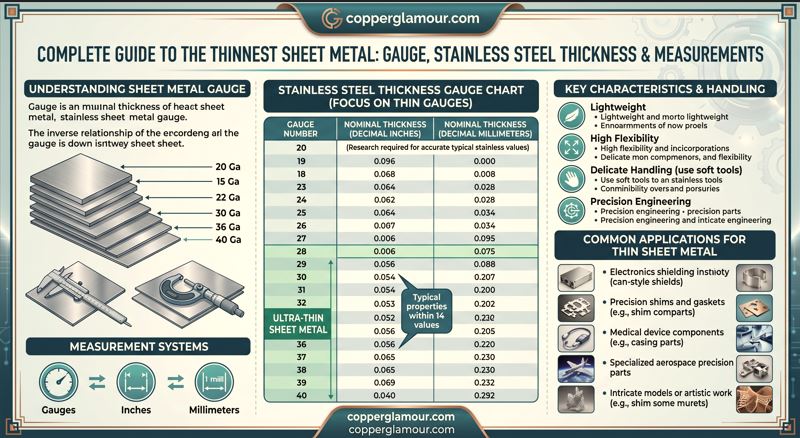
Thinnest Sheet Metal: Complete Guide to Gauge, Stainless Steel Thickness, and Measurements
The thinnest sheet metal depends on the metal, manufacturing process, and industry definition. Manufacturers can roll metals into extremely thin material, although very thin products are usually classified as metal foil rather than sheet metal. For everyday fabrication, stainless steel sheet is available in many gauges, with higher gauge numbers generally representing thinner material within the same gauge system.
Understanding this distinction matters because sheet metal thickness affects weight, flexibility, strength, fabrication, and cost. Moreover, a lower gauge number does not mean thinner material. In most traditional sheet-metal gauge systems, the relationship works in the opposite direction.
Metal also plays an important role in home design. While stainless steel provides a clean, contemporary appearance, copper introduces warmer tones. Shoppers can explore handcrafted copper kitchenware, drinkware, jewelry, and decorative pieces from Copper Glamour to combine these different metallic finishes throughout the home.
What Is the Thinnest Sheet Metal?
There is no single universal thickness that qualifies as the thinnest sheet metal.
Manufacturers can produce aluminum, stainless steel, copper, brass, and other metals in extremely thin forms. However, as thickness decreases, industry terminology often changes from sheet to foil.
For example, copper can be manufactured as extremely thin foil for electronics and other specialized applications. Similarly, aluminum foil demonstrates how thin a metal can become while remaining functional.
Therefore, the thinnest commercially available metal depends on the material and application rather than one universal gauge number.
What Is Sheet Metal?
Sheet metal is metal that manufacturers have formed into relatively thin, flat pieces.
It appears in countless applications, including:
- Automotive components
- Aircraft
- Appliances
- Roofing
- Kitchen equipment
- HVAC systems
- Electronics
- Cabinets
- Industrial equipment
- Decorative products
Furthermore, manufacturers can cut, bend, stamp, weld, and form sheet into complex shapes.
The appropriate thickness depends on the intended application. A decorative panel may require only lightweight material, while structural equipment may need considerably thicker sheet.
How Does Sheet Metal Gauge Work?
Gauge is a traditional method for describing metal thickness.
One of the most important rules is straightforward:
A higher gauge number generally means thinner sheet, while a lower gauge number means thicker sheet within the same applicable gauge system.
For example, under a commonly used stainless sheet convention, 22-gauge stainless steel is thinner than 16-gauge stainless steel.
However, gauge is not a direct measurement.
Twenty gauge does not mean 20 millimeters or 0.20 inches. Instead, each gauge number corresponds to a predefined nominal thickness.
Consequently, using millimeters or decimal inches often makes comparisons easier.
Stainless Steel Gauge Explained
Stainless steel gauge identifies nominal sheet thickness according to an established gauge convention.
For example, commonly referenced values include approximately:
20 gauge: 0.0359 inches or 0.91 mm
18 gauge: 0.0478 inches or 1.21 mm
16 gauge: 0.0598 inches or 1.52 mm
14 gauge: 0.0747 inches or 1.90 mm
Notice how the sheet becomes thicker as the gauge number decreases.
Nevertheless, you should always identify the material before converting a gauge number. Aluminum, standard steel, galvanized steel, and stainless steel do not necessarily share identical gauge-to-thickness values.
For technical projects, the National Institute of Standards and Technology provides authoritative information about measurement science and standards in the United States.
Stainless Sheet Metal Gauge
A stainless sheet metal gauge helps fabricators select an appropriate material thickness without writing a decimal measurement every time.
However, this convenience can also cause confusion.
Suppose someone asks for 16-gauge metal without specifying the material. That information may not be sufficient because the corresponding thickness can depend on the applicable material standard.
Therefore, professional specifications commonly provide additional information, including the alloy, physical thickness, tolerance, dimensions, and surface finish.
This approach reduces ambiguity.
Stainless Steel Sheet Thickness Chart
A stainless steel sheet thickness chart converts gauge numbers into physical dimensions.
Here are several commonly referenced nominal stainless steel sheet measurements:
24 gauge: approximately 0.0239 inches, 0.61 mm
22 gauge: approximately 0.0299 inches, 0.76 mm
20 gauge: approximately 0.0359 inches, 0.91 mm
18 gauge: approximately 0.0478 inches, 1.21 mm
16 gauge: approximately 0.0598 inches, 1.52 mm
14 gauge: approximately 0.0747 inches, 1.90 mm
12 gauge: approximately 0.1046 inches, 2.66 mm
10 gauge: approximately 0.1406 inches, 3.57 mm
These figures provide useful reference points. However, actual products may have manufacturing tolerances. Therefore, always check the supplier’s technical specification when precise dimensions matter.
Stainless Steel Sheet Thickness
Stainless steel sheet thickness affects far more than weight.
Generally, thicker sheet offers greater rigidity and resistance to bending. However, it also weighs more and usually requires more material.
Meanwhile, thinner stainless steel can be easier to form and lighter to transport. Nevertheless, a thin unsupported panel may flex more easily.
Consequently, selecting the right thickness requires balancing several factors:
- Strength
- Weight
- Rigidity
- Cost
- Formability
- Welding requirements
- Appearance
- Support structure
- Intended application
Choosing the thickest material available is not automatically the best solution.
Gauge 16 Stainless Steel
Gauge 16 stainless steel is approximately 0.0598 inches or 1.52 mm thick under a commonly referenced U.S. stainless sheet convention.
This thickness can appear in commercial kitchen equipment, work surfaces, sinks, fabricated components, cabinets, and other applications.
However, material thickness alone does not determine performance.
For example, stainless steel grade matters. The shape of the component also affects rigidity. Furthermore, bends, supports, welds, and mounting methods can dramatically change how a finished product performs.
Therefore, evaluate the complete design rather than relying only on gauge.
16 Gauge vs 18 Gauge Stainless Steel
People frequently compare 16 and 18 gauge because both appear in stainless products.
Under a commonly referenced stainless sheet convention:
16 gauge: approximately 1.52 mm
18 gauge: approximately 1.21 mm
Therefore, 16 gauge is thicker.
That extra material can provide additional rigidity. On the other hand, 18-gauge stainless weighs less and may provide sufficient performance for many applications.
The correct choice depends on the product rather than a simple assumption that thicker always means better.
Understanding 7ga Steel Thickness
7ga steel thickness demonstrates how dramatically thickness increases as gauge numbers decrease.
Under a commonly referenced U.S. standard sheet-steel convention, 7-gauge steel is approximately 0.1793 inches, or 4.55 mm thick.
However, there is an important distinction.
That figure relates to a standard steel gauge convention. You should not automatically apply the same measurement to stainless steel, aluminum, or another material.
Instead, consult the gauge chart for the specific metal involved.
Why 7 Gauge Is Much Thicker Than 16 Gauge
Gauge numbers work in the opposite direction from what many first-time buyers expect.
A 7-gauge sheet is relatively heavy, while 16-gauge sheet is considerably thinner within the relevant systems.
Therefore, decreasing the gauge number increases thickness rather than reducing it.
This system becomes easier to understand when you convert gauge into millimeters or inches. Actual dimensions immediately reveal the difference.
Gauge Stainless Measurements
A search for gauge stainless often leads to charts showing several gauge numbers.
However, verify that the chart specifically applies to stainless steel sheet.
Wire gauge is different from sheet gauge. Likewise, aluminum gauge measurements may differ from stainless measurements.
For this reason, a technical specification such as 1.52 mm stainless steel sheet communicates thickness more clearly than simply writing “16 gauge.”
Stainless Steel Sheet Gauge vs Wire Gauge
A stainless steel sheet gauge should not be confused with wire gauge.
Sheet gauge measures the nominal thickness of flat metal. In contrast, wire gauge describes wire diameter according to the applicable wire standard.
For example, American Wire Gauge, commonly called AWG, should not be used as a conversion chart for stainless steel sheet.
Although both systems use numbers, they measure different products.
Therefore, always confirm which gauge system appears in a technical specification.
Does Stainless Steel Grade Affect Sheet Thickness?
Stainless steel grade and thickness describe different characteristics.
For example, 304 and 316 stainless steel are alloy grades. Meanwhile, 16 gauge describes nominal sheet thickness under the applicable convention.
A manufacturer can produce both alloys in numerous thicknesses.
According to Encyclopaedia Britannica’s overview of stainless steel, chromium is central to stainless steel’s corrosion-resistant characteristics. Other alloying elements can further change material properties.
Consequently, buyers should consider both the alloy grade and thickness.
304 vs 316 Stainless Steel
304 stainless steel is widely used in household, food-service, architectural, and industrial applications.
Meanwhile, 316 stainless steel contains molybdenum and generally provides improved resistance in certain corrosive environments, particularly those involving chlorides.
However, 316 is not automatically necessary for every project.
Indoor decorative applications may have very different requirements from marine, chemical, or industrial environments. Therefore, material selection should reflect actual operating conditions.
Is Thinner Sheet Metal Better?
Sometimes.
Thin sheet can reduce weight and material usage. Furthermore, it may be easier to bend or form for certain applications.
However, thin material may also require additional reinforcement.
For example, a thin decorative panel attached to a rigid surface may perform perfectly well. In contrast, an unsupported work surface may need substantially more rigidity.
Therefore, the ideal thickness depends on design requirements rather than simply choosing the thinnest sheet metal available.
Is Thicker Sheet Metal Stronger?
Increasing thickness can increase a component’s resistance to deformation, assuming other factors remain comparable.
However, thickness is only part of the engineering equation.
Material grade, geometry, bends, supports, loading direction, welds, fasteners, and manufacturing processes can all affect strength.
Consequently, safety-critical projects should follow qualified engineering specifications rather than relying solely on a general gauge chart.
How Is Stainless Steel Sheet Thickness Measured?
Fabricators commonly use precision tools such as calipers or micrometers to measure sheet thickness.
These tools provide actual dimensions rather than gauge designations.
For example, a micrometer may show a measurement close to 1.52 mm for nominal 16-gauge stainless sheet.
Actual measurements can vary slightly because manufacturing tolerances exist. Therefore, projects requiring strict precision should specify acceptable tolerance ranges.
Thin Sheet Metal in Kitchen Design
Stainless sheet appears frequently in kitchens because it offers a clean appearance and practical corrosion resistance.
Manufacturers use stainless steel for:
- Backsplashes
- Countertops
- Sinks
- Appliances
- Worktables
- Cabinets
- Shelving
- Cookware
However, homeowners do not need to use only one metal throughout the room.
Warm copper accents can contrast beautifully with cooler stainless surfaces. For example, copper mugs, pitchers, bowls, serving pieces, or decorative accessories can add visual warmth without changing the kitchen’s core design.
Explore handcrafted copper products from Copper Glamour for kitchen and home styling inspiration.
Copper Sheet Can Also Be Extremely Thin
Copper provides another excellent example of a metal that manufacturers can roll into very thin sheets and foils.
Its malleability makes it suitable for numerous decorative and industrial applications. Furthermore, copper’s distinctive color makes it especially popular for interior accents.
According to the Royal Society of Chemistry’s copper resource, copper is highly conductive and malleable, characteristics that contribute to its broad range of uses.
Copper and stainless steel therefore serve different purposes while also complementing one another visually.
Choosing the Right Sheet Metal Thickness
Begin with the intended application.
A decorative wall panel has different requirements from a commercial worktable. Likewise, an automotive body component differs considerably from structural fabrication.
Next, consider how the sheet will be supported.
A large unsupported surface may require additional thickness or reinforcement. Meanwhile, a smaller panel mounted to a solid backing may perform well with thinner material.
Finally, consider fabrication requirements. Cutting, bending, forming, and welding become different as thickness changes.
Therefore, choose thickness according to the complete project rather than gauge alone.
Where to Buy Sheet Metal in the USA
USA buyers can purchase sheet metal through local metal suppliers, industrial distributors, fabrication shops, hardware suppliers, and specialist online retailers.
Before ordering, specify the exact:
- Metal type
- Alloy or grade
- Gauge
- Thickness in inches or millimeters
- Width and length
- Finish
- Quantity
- Required tolerance
Furthermore, confirm whether the supplier’s gauge chart matches the material specified in your project.
For finished copper home, kitchen, dining, and decorative products rather than raw sheet metal, explore Copper Glamour.
Frequently Asked Questions
What is the thinnest sheet metal?
There is no single universal minimum. Manufacturers can produce extremely thin metal, but once it reaches very small thicknesses, the product is generally described as foil rather than sheet.
Does higher gauge mean thinner metal?
Generally, yes, within the same applicable sheet-metal gauge system. For example, 20-gauge stainless sheet is thinner than 16-gauge stainless sheet.
How thick is gauge 16 stainless steel?
Under a commonly referenced U.S. stainless sheet convention, 16 gauge is approximately 0.0598 inches or 1.52 mm.
What is 7ga steel thickness?
Under a commonly referenced standard sheet-steel convention, 7 gauge is approximately 0.1793 inches or 4.55 mm. However, confirm the specific material and gauge standard before using this figure.
Is stainless steel gauge the same as regular steel gauge?
Not necessarily. Gauge-to-thickness values depend on the applicable material and standard. Therefore, always use the correct chart.
What is a stainless steel sheet thickness chart?
It is a reference that converts stainless sheet gauge numbers into physical measurements, typically decimal inches and millimeters.
Is thinner stainless steel cheaper?
Thinner sheet uses less material, which can reduce material cost. However, final pricing also depends on alloy grade, finish, sheet dimensions, quantity, fabrication, and market conditions.
Final Thoughts
The thinnest sheet metal cannot be defined by one universal gauge because thickness classifications vary according to material, manufacturing process, and application. At extremely low thicknesses, manufacturers commonly describe metal as foil rather than sheet.
Additionally, understanding stainless steel gauge, stainless sheet metal gauge, and stainless steel sheet thickness can prevent costly measurement mistakes. Remember that higher gauge numbers generally represent thinner material within the same applicable system. Meanwhile, 16-gauge stainless steel is approximately 0.0598 inches or 1.52 mm under a commonly referenced U.S. stainless sheet convention.
For technical projects, always verify the material, alloy, actual thickness, tolerance, and applicable standard with your supplier. Finally, homeowners interested in mixing different metals can combine modern stainless steel surfaces with the distinctive warmth of handcrafted kitchenware, drinkware, jewelry, and décor from Copper Glamour.