Stainless Sheet Metal Gauge: Complete Stainless Steel Thickness Guide
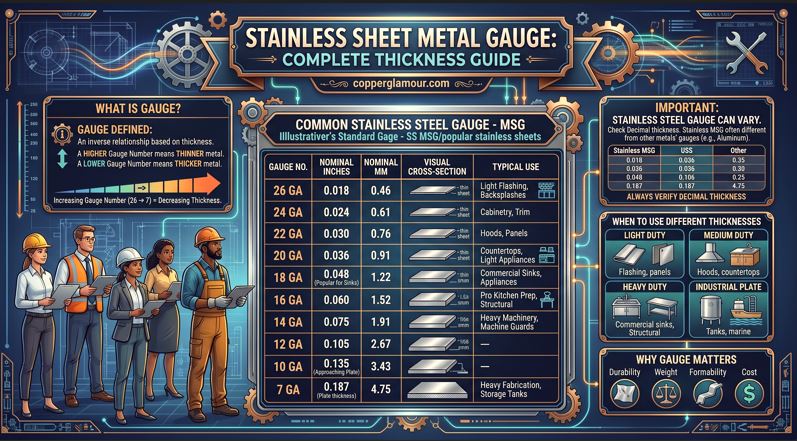
Stainless sheet metal gauge is a system used to identify the nominal thickness of stainless steel sheet. In commonly referenced U.S. gauge conventions, a lower gauge number represents thicker stainless sheet, while a higher gauge number represents thinner material. For example, 16-gauge stainless steel is approximately 0.0598 inches, or 1.52 mm, thick.
However, gauge numbers can easily cause confusion. A gauge is not a direct unit such as an inch or millimeter. Additionally, the same gauge number can represent different thicknesses for different metals. Therefore, buyers, fabricators, homeowners, and contractors should always confirm both the material and its actual thickness.
Stainless steel also plays a major role in modern interior design. Its cooler silver finish can pair particularly well with warm metals such as copper. At Copper Glamour, shoppers can explore copper kitchenware, drinkware, serveware, jewelry, and decorative pieces that complement stainless steel surfaces.
What Is Stainless Sheet Metal Gauge?
Stainless sheet metal gauge is a traditional system for describing the thickness of flat stainless steel.
Instead of identifying thickness directly in millimeters or decimal inches, the system assigns a gauge number.
For example, common stainless sheet gauges include 24, 22, 20, 18, 16, 14, 12, and 10.
The relationship can initially seem backward. As the gauge number decreases, the material generally becomes thicker within the same gauge convention.
Therefore:
24 gauge is thinner than 20 gauge.
20 gauge is thinner than 18 gauge.
18 gauge is thinner than 16 gauge.
16 gauge is thinner than 14 gauge.
This pattern makes the gauge system easier to understand once you remember that smaller gauge usually means thicker sheet.
Stainless Steel Sheet Thickness Chart
A stainless steel sheet thickness chart converts gauge numbers into actual measurements.
Common nominal stainless sheet measurements under a widely referenced U.S. convention include:
| Stainless Steel Gauge | Approx. Inches | Approx. Millimeters |
|---|---|---|
| 30 GA | 0.0120 in | 0.30 mm |
| 28 GA | 0.0156 in | 0.40 mm |
| 26 GA | 0.0179 in | 0.45 mm |
| 24 GA | 0.0239 in | 0.61 mm |
| 22 GA | 0.0299 in | 0.76 mm |
| 20 GA | 0.0359 in | 0.91 mm |
| 18 GA | 0.0478 in | 1.21 mm |
| 16 GA | 0.0598 in | 1.52 mm |
| 14 GA | 0.0747 in | 1.90 mm |
| 12 GA | 0.1046 in | 2.66 mm |
| 10 GA | 0.1406 in | 3.57 mm |
These values are useful nominal references rather than substitutes for a manufacturer’s engineering specification. Consequently, projects requiring precise dimensions should also check tolerances and the standard specified by the supplier.
How Does Stainless Steel Sheet Thickness Work?
Stainless steel sheet thickness is the actual physical distance between the two faces of a flat sheet.
Unlike gauge, thickness can be expressed directly.
For example:
0.0598 inches is a direct measurement.
1.52 mm is also a direct measurement.
16 gauge, however, is a designation that corresponds to a nominal thickness under a particular system.
Therefore, actual measurements are often easier to understand, especially when working with international suppliers.
The National Institute of Standards and Technology provides authoritative information about measurement science and standards used across the United States.
Why Does Stainless Steel Gauge Work Backward?
People frequently assume a larger gauge number should mean thicker material. However, traditional sheet-metal gauge systems generally operate in the opposite direction.
As gauge numbers increase, sheet thickness decreases.
This numbering system developed historically rather than as a modern decimal measurement system. Consequently, the difference between gauges is not necessarily linear.
For example, moving from 18 gauge to 16 gauge does not simply add two millimeters.
Instead, each designation corresponds to a predetermined nominal thickness.
Because of this, a conversion chart becomes valuable whenever you work with gauge stainless materials.
What Is Gauge 16 Stainless Steel?
Gauge 16 stainless steel is approximately 0.0598 inches or 1.52 mm thick under a commonly referenced U.S. stainless sheet convention.
This is a useful middle-range thickness for many fabricated products.
Depending on the alloy, product design, and structural requirements, material around this thickness can appear in kitchen equipment, work surfaces, sinks, panels, cabinets, shelving, and industrial components.
However, gauge alone does not determine performance.
Material grade, shape, supports, bends, welds, fasteners, and overall construction can dramatically affect the finished product.
16GA Stainless Steel Thickness
The terms 16GA stainless steel thickness, 16 ga stainless thickness, and gauge 16 stainless steel generally refer to the same nominal thickness question.
A commonly referenced conversion is:
16GA stainless = 0.0598 inches = approximately 1.52 mm.
However, nominal thickness should not be confused with a guaranteed exact dimension.
Manufacturing processes involve tolerances. Therefore, the finished material may vary slightly from the nominal value while remaining within the applicable specification.
For precision fabrication, ask the supplier for its tolerance range.
16 Gauge vs 18 Gauge Stainless Steel
16-gauge stainless steel is thicker than 18-gauge stainless steel.
Under a commonly referenced stainless sheet convention:
16 gauge: approximately 0.0598 inches or 1.52 mm.
18 gauge: approximately 0.0478 inches or 1.21 mm.
Therefore, 16 gauge provides greater nominal material thickness.
However, thicker material is not automatically superior.
For example, 18-gauge sheet may provide sufficient rigidity for a properly designed and supported component while reducing weight and material use.
The appropriate choice depends on the application.
16 Gauge vs 20 Gauge Stainless Steel
The difference becomes larger when comparing 16 and 20 gauge.
16 gauge: approximately 1.52 mm.
20 gauge: approximately 0.91 mm.
Consequently, 16-gauge material contains substantially more thickness.
Nevertheless, many products do not require 16-gauge construction. A decorative panel, for example, may work effectively with considerably thinner material when it has proper backing.
Therefore, thickness should match the design requirements.
Stainless Steel Sheet Gauge vs Regular Steel Gauge
A stainless steel sheet gauge should not automatically be treated as identical to a standard carbon-steel gauge.
Gauge conversions depend on the material and standard involved.
Likewise, aluminum has its own relevant conversions. Wire gauge uses yet another system.
Therefore, simply stating “16 gauge metal” can be ambiguous.
A clearer description would identify:
Material: stainless steel
Gauge: 16 GA
Nominal thickness: approximately 0.0598 inches
Metric thickness: approximately 1.52 mm
This approach significantly reduces the risk of ordering the wrong material.
Stainless Steel Gauge vs Wire Gauge
Sheet gauge and wire gauge are not interchangeable.
A stainless sheet gauge identifies nominal sheet thickness. Meanwhile, a wire gauge system identifies wire diameter.
For example, American Wire Gauge, commonly called AWG, applies primarily to electrically conducting wire and should not be used as a stainless sheet thickness chart.
Therefore, always verify what type of product a gauge specification describes.
Stainless Steel Thickness Chart vs Gauge Chart
A stainless steel thickness chart and a stainless gauge chart often contain similar information.
However, a good reference should provide more than the gauge number. Ideally, it should include thickness in both decimal inches and millimeters.
Metric measurements are particularly useful because they make physical differences easier to understand.
For example, comparing 1.52 mm with 0.91 mm immediately shows that the first sheet is considerably thicker.
Meanwhile, comparing “16 gauge” and “20 gauge” requires prior knowledge of the gauge system.
Does Stainless Steel Grade Change the Gauge?
Grade and gauge describe different properties.
Gauge describes nominal thickness. In contrast, stainless steel grade describes alloy composition and related material characteristics.
For example, 304 and 316 stainless steel can both be produced in numerous thicknesses.
The Encyclopaedia Britannica guide to stainless steel explains how chromium and other alloying elements contribute to the characteristics of stainless steel.
Consequently, specifying “16 gauge” alone does not tell you whether the material is 304, 316, or another stainless grade.
304 Stainless Steel Sheet
304 stainless steel is widely used in household, architectural, food-service, and industrial products.
It provides useful corrosion resistance for many everyday environments. Additionally, manufacturers can form and fabricate it into numerous products.
However, its suitability depends on operating conditions.
For example, a household backsplash and an industrial component may require very different finishes, thicknesses, tolerances, and fabrication methods even when both use 304 stainless.
Therefore, always consider the complete specification.
316 Stainless Steel Sheet
316 stainless steel contains molybdenum, which generally improves resistance in certain corrosive environments, particularly those involving chlorides.
Consequently, manufacturers may select it for marine, chemical, food-processing, and other demanding environments.
However, 316 stainless steel is not automatically necessary for every application.
For many indoor household products, another stainless grade may provide suitable performance at a lower cost.
Again, grade and gauge should be evaluated separately.
Does Thicker Stainless Steel Mean Better Quality?
Not necessarily.
A thicker sheet generally provides more rigidity and material. Nevertheless, quality depends on several additional factors.
For example, alloy grade affects corrosion resistance. Fabrication quality influences joints and finished geometry. Meanwhile, proper structural design determines how effectively the material carries loads.
A thin stainless panel attached to strong reinforcement may perform exceptionally well.
Conversely, simply increasing thickness cannot correct poor design.
Therefore, select thickness according to engineering requirements rather than assuming the heaviest material is always best.
How to Measure Stainless Steel Thickness
Fabricators commonly measure stainless sheet with calipers or micrometers.
A micrometer can provide a precise physical thickness measurement. Therefore, it is particularly useful when verifying material against a technical specification.
For example, nominal 16-gauge stainless should measure close to its specified thickness, subject to manufacturing tolerances.
Coatings and surface treatments may affect certain measurements. Consequently, professional inspection should follow the appropriate material specification.
Stainless Steel Thickness for Kitchen Equipment
Stainless steel appears extensively in residential and commercial kitchens.
Manufacturers use it for sinks, backsplashes, appliances, countertops, tables, cabinets, shelving, and cookware.
However, there is no single ideal gauge for every kitchen product.
A sink requires different structural characteristics from a backsplash. Likewise, a commercial preparation table experiences different loads from a decorative appliance panel.
Therefore, consumers should evaluate the complete product rather than judging quality from gauge alone.
Stainless Steel and Copper in Kitchen Design
Stainless steel offers a cool, modern appearance. Meanwhile, copper provides a warmer and more traditional metallic tone.
Combining them can create visual balance.
For example, a kitchen with stainless appliances can incorporate copper mugs, bowls, pitchers, trays, serving pieces, or decorative accessories.
Furthermore, copper itself has distinctive physical characteristics. The Royal Society of Chemistry’s copper resource notes copper’s excellent thermal and electrical conductivity as well as its malleability.
For homeowners who enjoy mixing metallic finishes, explore handcrafted kitchen, dining, jewelry, and decorative pieces from Copper Glamour.
How to Choose the Correct Stainless Steel Gauge
Start with the application.
If the sheet serves primarily as a decorative covering over a rigid surface, a thinner material may work well. However, an unsupported work surface may require more rigidity.
Next, consider the environment. Moisture, salt, chemicals, heat, and outdoor exposure can influence the stainless grade you need.
Additionally, evaluate fabrication requirements. Thicker sheet can require more powerful cutting, bending, drilling, and welding equipment.
Finally, consider weight and cost.
Increasing thickness adds material. Consequently, a heavier gauge can increase both the finished product’s weight and material cost.
The best choice balances all these factors.
Where to Buy Stainless Steel Sheet in the USA
USA buyers can purchase stainless steel sheet through metal service centers, industrial distributors, fabrication companies, hardware suppliers, and specialized online metal retailers.
Before placing an order, confirm the material’s grade, gauge, actual nominal thickness, dimensions, finish, quantity, and applicable tolerance.
Additionally, ask which gauge standard the supplier uses. This small step can prevent expensive mistakes.
For finished decorative copper products rather than industrial raw metal, shoppers can browse kitchenware, drinkware, home accessories, and other handcrafted products from Copper Glamour.
Frequently Asked Questions
What does stainless sheet metal gauge mean?
It is a system used to designate the nominal thickness of stainless steel sheet. Generally, a lower gauge number means thicker material within the same applicable gauge convention.
How thick is 16GA stainless steel?
A commonly referenced nominal thickness for 16-gauge stainless steel is 0.0598 inches or approximately 1.52 mm.
Is 16 gauge thicker than 18 gauge stainless steel?
Yes. Under the same commonly referenced stainless sheet convention, 16 gauge is approximately 1.52 mm while 18 gauge is approximately 1.21 mm.
Is 20 gauge stainless thicker than 16 gauge?
No. Gauge numbers generally move opposite to thickness. Therefore, 20-gauge stainless sheet is thinner than 16-gauge material under the same convention.
Is stainless steel gauge the same for every metal?
No. Gauge-to-thickness conversions can vary according to material and system. Always use the appropriate chart for stainless steel, standard steel, aluminum, or another specific metal.
What is the difference between stainless steel gauge and thickness?
Gauge is a standardized designation. Thickness is the actual physical dimension expressed in units such as inches or millimeters.
Which stainless steel gauge is best?
There is no universally best gauge. The appropriate thickness depends on the product, structural requirements, environment, fabrication method, weight limits, and budget.
Final Thoughts
Understanding stainless sheet metal gauge becomes much easier once you remember one basic principle: within the same applicable system, lower gauge generally means thicker stainless steel.
A stainless steel sheet thickness chart then allows you to convert those gauge numbers into meaningful dimensions. For example, 16GA stainless steel thickness is commonly listed at approximately 0.0598 inches or 1.52 mm.
However, never choose material from gauge alone. Instead, consider stainless grade, actual thickness, manufacturing tolerance, dimensions, support, fabrication, and intended environment.
Finally, metal does not need to serve only a technical purpose. Stainless steel’s contemporary appearance can pair beautifully with warmer copper finishes. Explore handcrafted kitchenware, drinkware, jewelry, serving pieces, and home décor from Copper Glamour.