Atomic Symbol for Copper: Why Cu Represents Copper and What It Tells Us
Atomic Symbol for Copper
The atomic symbol for copper is Cu. This official symbol identifies copper on the periodic table and in scientific research, engineering, chemistry, and manufacturing. Scientists around the world use Cu because it provides a universal way to identify the element regardless of language.
At Copper Glamour, we value copper for its remarkable combination of beauty, durability, and functionality. Whether crafted into elegant jewelry or practical kitchenware, copper remains one of the world’s most admired metals.
According to Wikipedia’s article on Copper, copper has served civilizations for thousands of years and continues to play a critical role in modern technology, renewable energy, architecture, transportation, and manufacturing.
Explore the Copper Glamour Collection to discover handcrafted copper products inspired by this extraordinary element.
What Is the Atomic Symbol for Copper?
The official atomic symbol for copper is Cu.
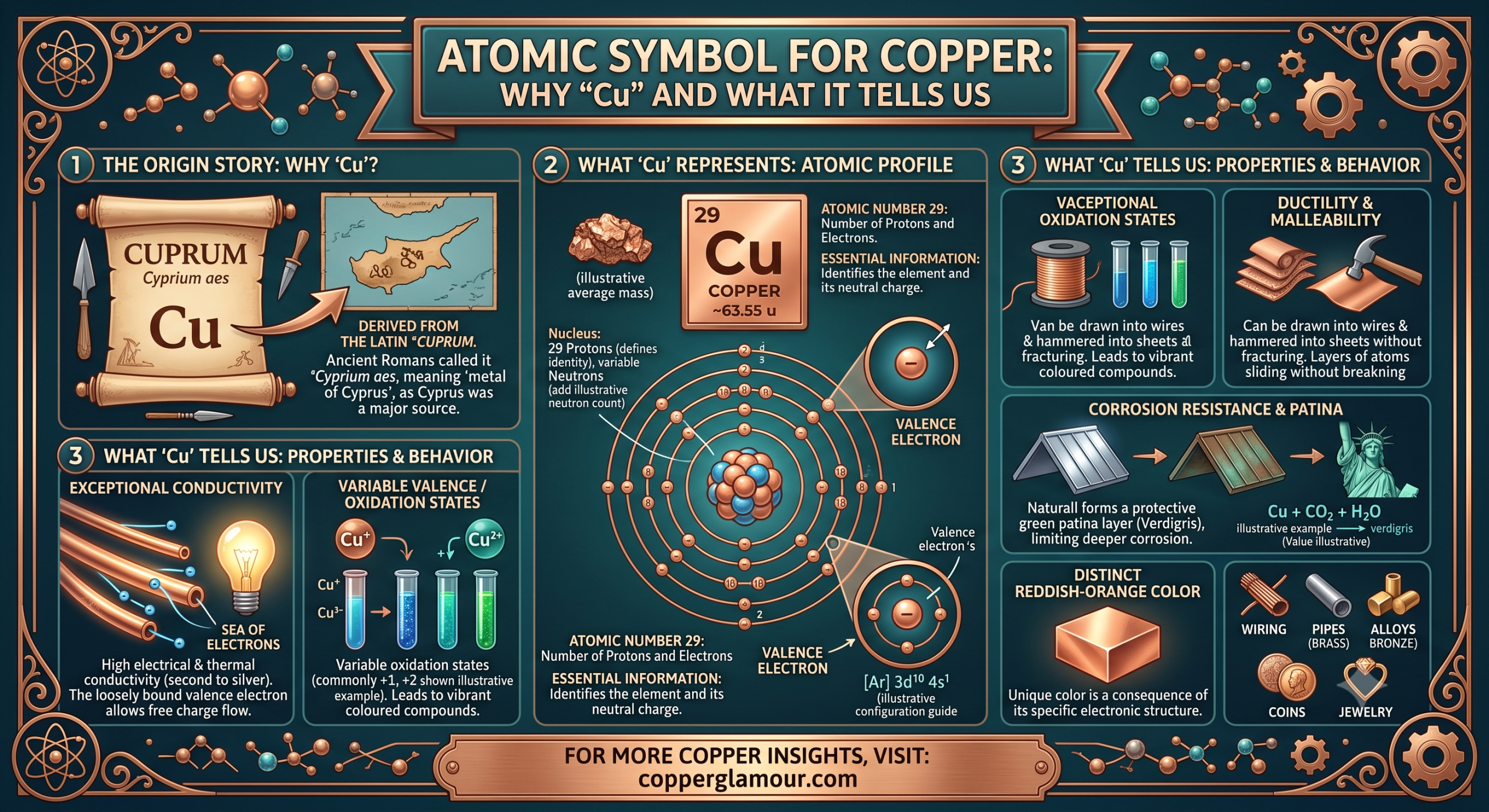
The symbol originates from the Latin word Cuprum, which became the accepted scientific name for copper centuries ago. Therefore, whenever you see Cu on the periodic table, in a chemistry textbook, or on an engineering diagram, it always represents copper.
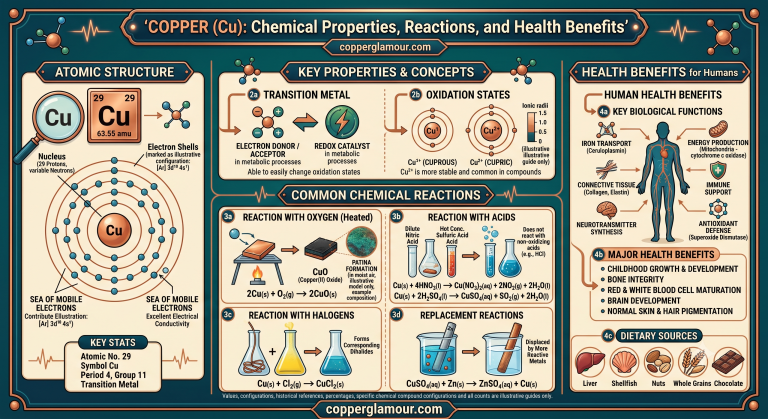
Copper’s scientific information includes:
- Element: Copper
- Atomic symbol: Cu
- Chemical symbol: Cu
- Atomic number: 29
- Atomic mass: 63.546 u
- Classification: Transition metal
Copper in Latin
Many people search for copper in Latin or the Latin name for copper.
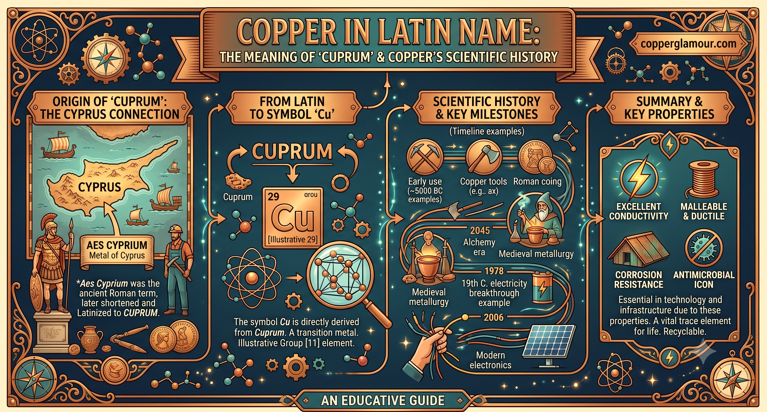
The Latin name for copper is Cuprum.
Historically, the word evolved from aes Cyprium, meaning “metal of Cyprus.” Since Cyprus supplied large quantities of copper during ancient times, the metal became closely associated with the island. Consequently, scientists adopted Cu from Cuprum as the element’s official symbol.
Copper Name
The modern copper name reflects thousands of years of history.
Although many languages have their own word for copper, scientists and engineers consistently use the symbol Cu in research, education, and industry. As a result, the symbol creates a universal scientific language understood around the world.
Is Copper Metal or Nonmetal?
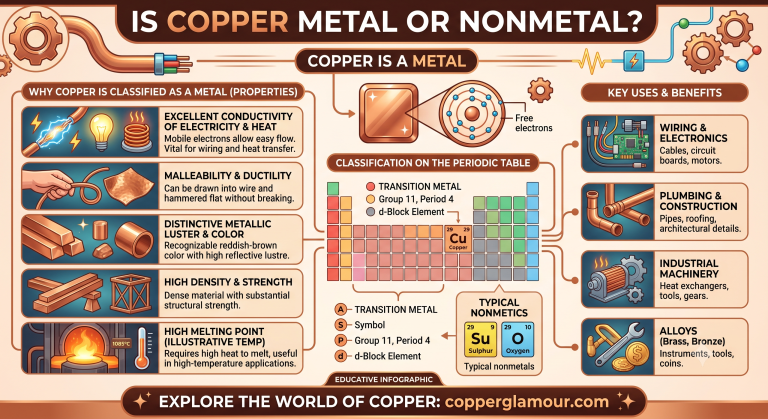
Copper is a metal, specifically a transition metal.
It belongs to Group 11 of the periodic table and possesses all the characteristics commonly associated with metals, including:
- Excellent electrical conductivity
- Outstanding thermal conductivity
- High malleability
- Excellent ductility
- Metallic luster
- Strong corrosion resistance
Because of these properties, copper remains one of the most widely used engineering materials worldwide.
Is Copper Metal?
Yes, copper is a metal.
Furthermore, it ranks among the most valuable industrial metals because it combines excellent performance with long-term durability. Manufacturers also appreciate copper because they can easily shape it into wires, pipes, sheets, and decorative products.
What Type of Metal Is Copper?
Copper is classified as a transition metal.
Transition metals are known for their strength, conductivity, and versatility. Consequently, copper has become indispensable in electrical systems, renewable energy, construction, transportation, telecommunications, and consumer products.
Is Copper an Element or Compound?
Copper is an element, not a compound.
Every sample of pure copper contains only copper atoms. Each copper atom has exactly 29 protons, which defines the element. In contrast, compounds contain two or more different elements chemically bonded together.
Therefore, copper is classified as a naturally occurring chemical element.
What Is Copper Made Out Of?
Many people ask, what is copper made out of?
Copper is not manufactured from other materials. Instead, it is a naturally occurring element that exists within copper-bearing ores found in the Earth’s crust.
After mining, producers refine the ore to remove unwanted minerals and produce high-purity copper for industrial and commercial applications.
Physical Properties of Copper Metal
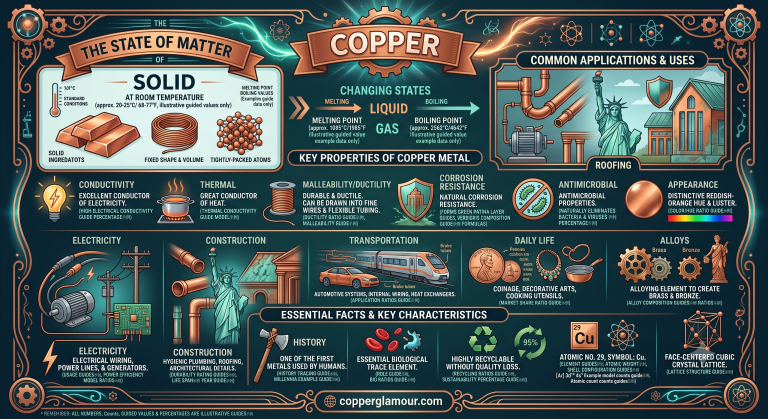
The outstanding physical properties of copper metal explain why industries continue to depend on it.
Copper features:
- Distinctive reddish-orange color
- Excellent electrical conductivity
- Outstanding thermal conductivity
- Density of approximately 8.96 g/cm³
- Melting point of approximately 1,084°C (1,983°F)
- Boiling point of approximately 2,562°C (4,644°F)
- Excellent malleability
- High ductility
- Natural corrosion resistance
- Excellent recyclability
As a result, copper performs exceptionally well in demanding industrial and household applications.
The American Chemical Society (ACS) provides additional educational information about copper’s chemistry and material science.
What Is Copper Atomic Mass?
Copper has an average atomic mass of 63.546 atomic mass units (u).
Scientists calculate this value using the weighted average of copper’s two naturally occurring stable isotopes:
- Copper-63
- Copper-65
Atomic mass helps researchers accurately identify elements and understand their chemical behavior.
Why Copper Is Used Around the World
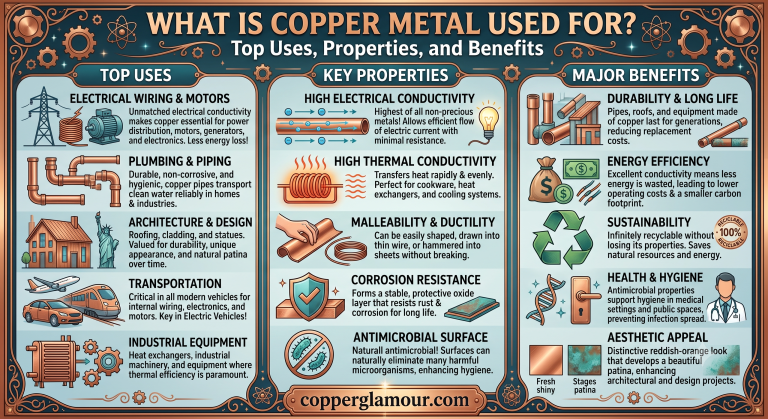
Copper’s unique combination of properties makes it valuable across numerous industries.
For example, manufacturers use copper in:
- Electrical wiring
- Printed circuit boards
- Solar panels
- Wind turbines
- Electric vehicles
- Plumbing systems
- Roofing
- Industrial machinery
- Telecommunications
- Kitchen cookware
- Jewelry
- Decorative home accessories
Moreover, copper can be recycled repeatedly without significantly losing its performance, making it an environmentally responsible material.
Research available through PubMed explores copper’s engineering and materials science applications. Additionally, the National Institutes of Health Office of Dietary Supplements explains copper’s essential role as a trace mineral in human nutrition.
Copper in Artisan Craftsmanship
Copper has inspired artisans for centuries because it combines durability with natural beauty.
Today, skilled craftspeople create copper mugs, bracelets, bowls, kettles, necklaces, and decorative accessories that highlight the metal’s warm appearance. Over time, these handcrafted pieces often develop a protective patina, which enhances their unique character while helping preserve the underlying metal.
Discover artisan-crafted collections at Copper Glamour, where traditional craftsmanship meets modern American design.
Frequently Asked Questions
What is the atomic symbol for copper?
The atomic symbol for copper is Cu.
Is copper metal or nonmetal?
Copper is a metal, specifically a transition metal.
Is copper an element or compound?
Copper is a naturally occurring element, not a compound.
What is copper made out of?
Copper consists entirely of copper atoms and is refined from naturally occurring copper ores.
What is copper atomic mass?
Copper has an average atomic mass of 63.546 u.
What type of metal is copper?
Copper is a transition metal that is highly conductive, corrosion-resistant, and durable.
Final Thoughts
The atomic symbol for copper is Cu, a designation derived from the Latin name Cuprum. Copper is a naturally occurring transition metal with an atomic number of 29 and an atomic mass of 63.546 u. Moreover, its outstanding electrical conductivity, corrosion resistance, durability, and recyclability make it one of the most valuable materials used in modern technology, renewable energy, construction, transportation, and handcrafted artisan products. Whether appreciated for its scientific importance or timeless beauty, copper continues to play an essential role in everyday life.
Discover handcrafted copper jewelry, cookware, mugs, and home décor at Copper Glamour.