What Is Copper Atomic Mass? Understanding Copper’s Atomic Weight and Scientific Properties
What Is Copper Atomic Mass?
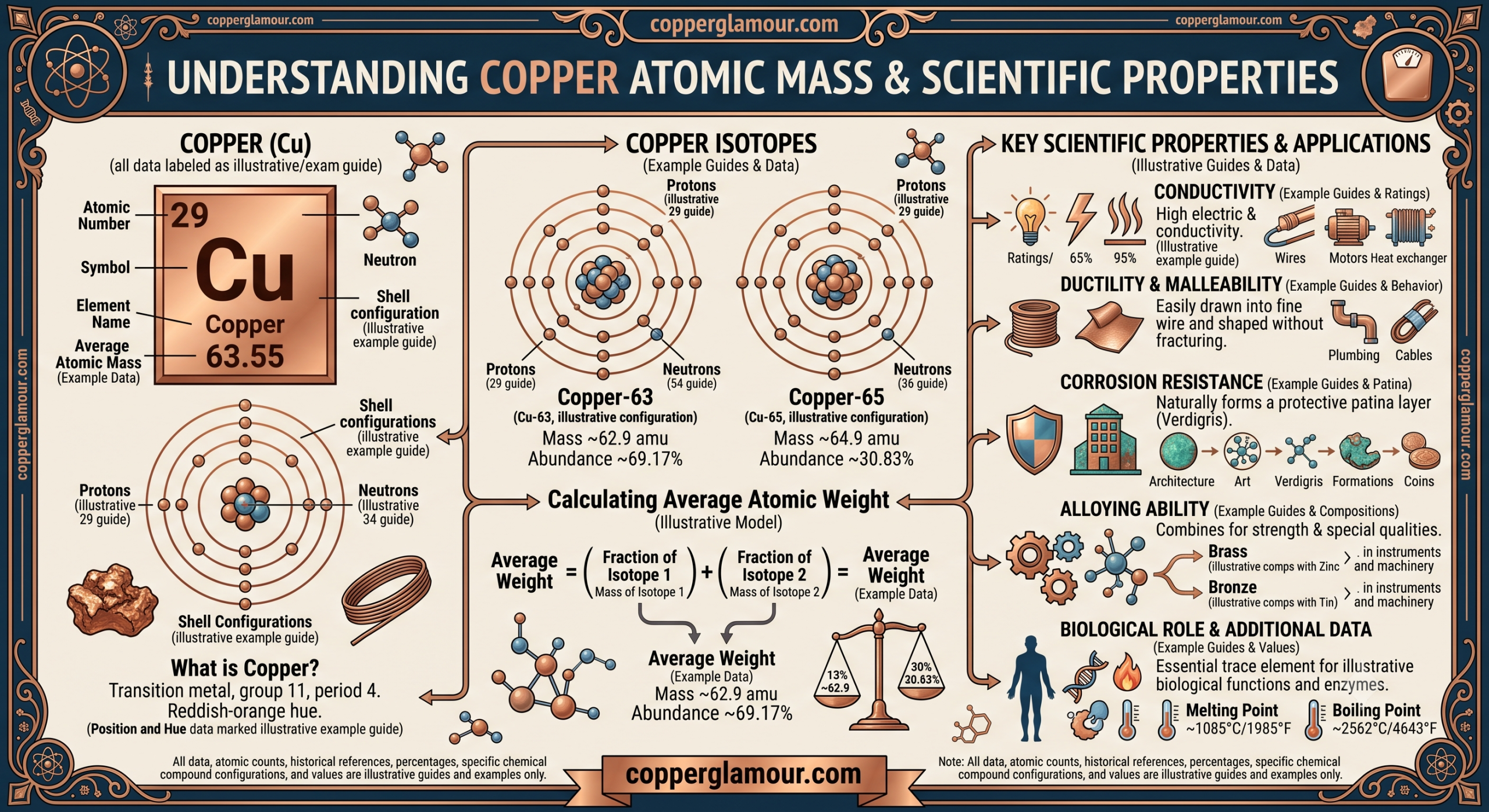
The atomic mass of copper is 63.546 atomic mass units (u). Atomic mass represents the average mass of naturally occurring copper atoms, taking into account the abundance of copper’s naturally occurring isotopes. It is one of the key scientific properties used to identify copper on the periodic table.
p⁺ · Protonn · Neutrone⁻ · Electron
35Cl
17 p⁺18 n
34.96885 u75.76%
37Cl
17 p⁺20 n
36.9659 u24.24%
Representative natural abundance
Weighted contribution (isotopic mass × fraction)
26.492 u
8.961 u
m=∑imifi=35.45294u
For Chlorine, 35.45294 u is approximately the periodic-table value 35.45 u
ElementBCNeMgSClCu
BCNeMgSClCu
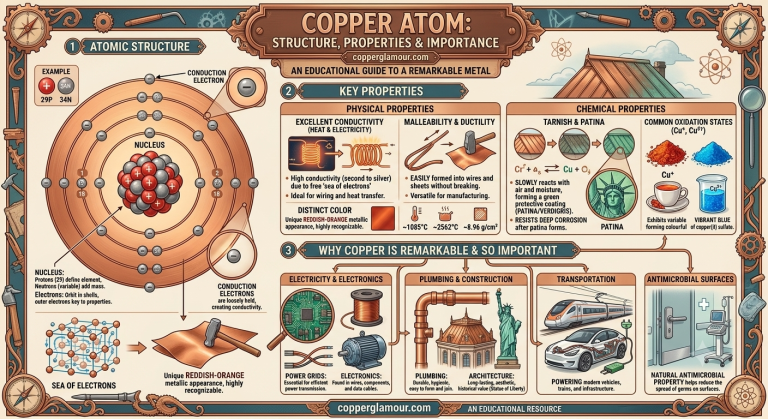
Copper has the chemical symbol Cu and an atomic number of 29, making it one of the most important transition metals used in modern technology, construction, renewable energy, transportation, and artisan craftsmanship.
At Copper Glamour, we celebrate copper’s remarkable properties by offering handcrafted jewelry, cookware, drinkware, and home décor that combine traditional craftsmanship with lasting durability.
According to Wikipedia’s article on Copper, copper has been mined and used for more than 10,000 years and remains one of the world’s most valuable engineering materials.
Explore the Copper Glamour Collection to discover artisan-crafted copper products.
What Is Atomic Mass?
Atomic mass is the average mass of an element’s atoms, measured in atomic mass units (u).
Rather than representing the mass of a single atom, atomic mass reflects the weighted average of all naturally occurring isotopes of an element. Therefore, the atomic mass shown on the periodic table accounts for the relative abundance of each isotope found in nature.
What Is Copper Atomic Mass?
Copper has an average atomic mass of 63.546 u.
This value results from two naturally occurring stable isotopes:
- Copper-63 (⁶³Cu), which is the more abundant isotope.
- Copper-65 (⁶⁵Cu), which is less abundant but still naturally present.
Because both isotopes occur naturally, scientists calculate a weighted average rather than using a whole number.
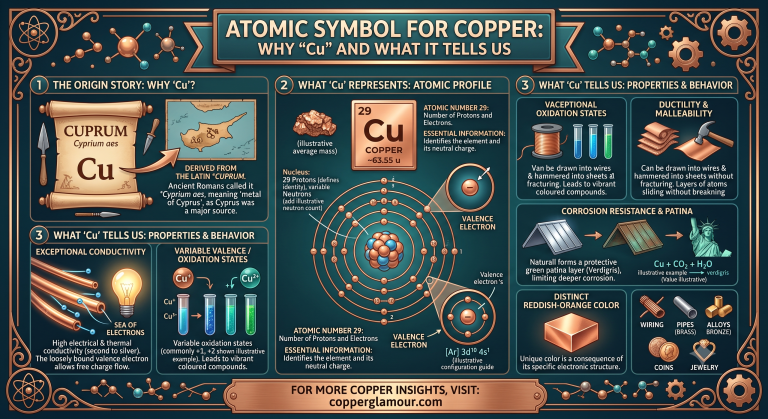
What Is the Symbol for the Following Element: Copper?
The official symbol for copper is Cu.
Copper’s scientific identity includes:
- Element: Copper
- Chemical symbol: Cu
- Atomic number: 29
- Atomic mass: 63.546 u
- Classification: Transition metal
The symbol Cu comes from the Latin name Cuprum, which remains the basis for copper’s scientific abbreviation.
Copper in Latin Name
The Latin name for copper is Cuprum.
The name evolved from the Latin phrase aes Cyprium, meaning “metal of Cyprus.” Ancient Cyprus was famous for its rich copper deposits, and the Romans associated the metal closely with the island. Consequently, the abbreviation Cu was adopted as copper’s official chemical symbol.
Copper Name
The English word copper developed gradually from the Latin Cuprum.
The historical progression is generally understood as:
- Aes Cyprium (“metal of Cyprus”)
- Cuprum
- Coper
- Copper
Although the spelling changed over time, scientists retained Cu as the universal symbol.
How Did Copper Get Its Name?
Copper received its name because ancient civilizations obtained large quantities of the metal from Cyprus.
Over time, the phrase aes Cyprium evolved into Cuprum, which later became the English word copper. Today, the symbol Cu continues to preserve this historical connection.
What Type of Element Is Copper?
Copper is a naturally occurring chemical element classified as a transition metal.
Transition metals are known for their:
- High electrical conductivity
- Excellent thermal conductivity
- Durability
- Ability to form alloys
- Metallic appearance
These characteristics explain why copper remains essential across countless industries.
What Type of Metal Is Copper?
Copper belongs to the transition metal family.
Unlike many engineering materials, copper combines outstanding conductivity with corrosion resistance and excellent workability. As a result, manufacturers use it extensively in electrical wiring, electronics, renewable energy systems, plumbing, transportation, and architecture.
Is Copper Metal?
Yes, copper is a metal.
More specifically, it is one of the world’s most important industrial metals because it performs exceptionally well under demanding conditions while remaining highly recyclable.
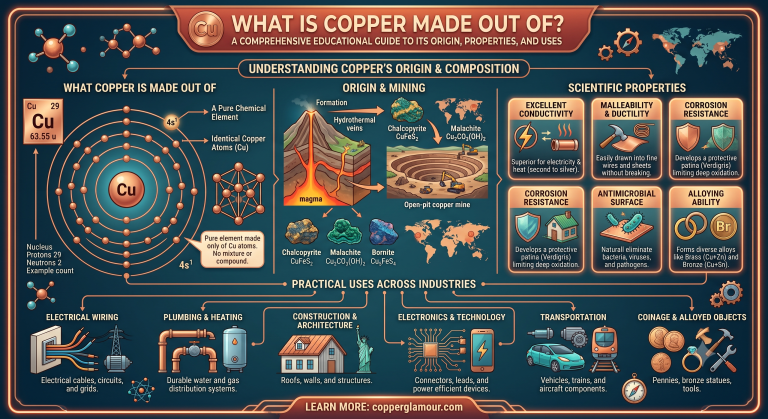
What Is Copper Made Out Of?
Copper is not made from other materials.
Instead, it is a naturally occurring chemical element found in copper-bearing mineral ores beneath the Earth’s surface. After mining, the ore is refined to remove impurities and produce high-purity copper suitable for manufacturing and decorative applications.
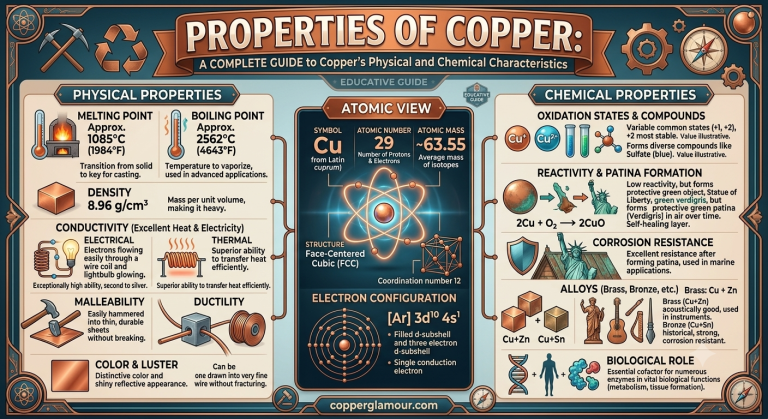
What Are Copper’s Chemical Properties?
Copper possesses several important chemical properties.
These include:
- Naturally forms a protective oxide layer.
- Common oxidation states of +1 and +2.
- Moderate chemical reactivity.
- Strong corrosion resistance.
- Excellent ability to form alloys such as:
- Brass (copper and zinc)
- Bronze (copper and tin)
These properties contribute significantly to copper’s long service life.
The American Chemical Society (ACS) provides additional educational information about copper’s chemistry and materials science.
What Is the State of Matter of Copper?
Under normal room-temperature conditions, copper exists as a solid.
Its melting point is approximately 1,084°C (1,983°F), while its boiling point is approximately 2,562°C (4,644°F). Therefore, copper remains solid during everyday use, making it ideal for electrical systems, plumbing, cookware, and structural applications.
Why Copper Remains So Valuable
Copper’s combination of physical and chemical properties has made it indispensable for modern society.
Today, industries use copper in:
- Electrical wiring
- Printed circuit boards
- Renewable energy systems
- Electric vehicles
- Telecommunications
- Plumbing
- Roofing
- Industrial equipment
- Jewelry
- Cookware
- Decorative home accessories
Additionally, copper can be recycled repeatedly without losing its valuable properties, making it an environmentally responsible material.
Research available through PubMed explores copper’s engineering and materials science applications. The National Institutes of Health Office of Dietary Supplements also explains copper’s role as an essential trace mineral in human nutrition.
Copper in Artisan Craftsmanship
Copper’s durability, warm appearance, and workability have inspired artisans for centuries.
Today, skilled craftspeople continue creating mugs, kettles, bowls, bracelets, necklaces, and decorative accessories that showcase the metal’s natural elegance. Over time, many handcrafted copper pieces develop a protective patina that enhances both their beauty and longevity.
Browse artisan-crafted collections at Copper Glamour, where traditional craftsmanship meets modern American design.
Frequently Asked Questions
What is copper atomic mass?
Copper has an average atomic mass of 63.546 atomic mass units (u).
What is the symbol for the element copper?
The official chemical symbol for copper is Cu.
What type of element is copper?
Copper is a transition metal and a naturally occurring chemical element.
What are copper’s chemical properties?
Copper forms a protective oxide layer, commonly exhibits +1 and +2 oxidation states, resists corrosion, and readily forms useful alloys such as brass and bronze.
What is the state of matter of copper?
Copper is a solid under normal room-temperature conditions.
How did copper get its name?
Copper’s name comes from the Latin Cuprum, which evolved from aes Cyprium, meaning “metal of Cyprus.”
Final Thoughts
The answer to “What is copper atomic mass?” is 63.546 atomic mass units (u). This value reflects the weighted average of copper’s naturally occurring isotopes and is one of the defining characteristics of the element. Together with its chemical symbol Cu, transition metal classification, excellent conductivity, corrosion resistance, and recyclability, copper remains an essential material in modern engineering, renewable energy, architecture, transportation, and artisan craftsmanship. Its remarkable combination of scientific importance and timeless beauty ensures that copper continues to play a vital role in everyday life.
Discover handcrafted copper jewelry, cookware, drinkware, and home décor at Copper Glamour.