16 Piece Crockery Set: Complete Guide to Choosing Dinnerware for Your Home
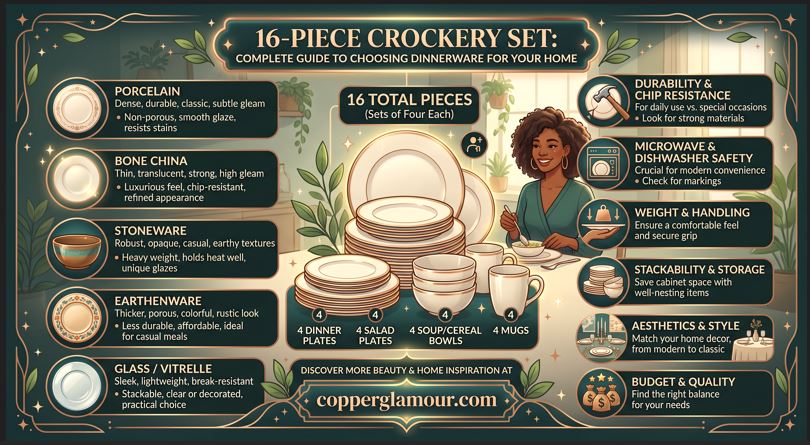
A 16 piece crockery set typically provides coordinated dinnerware for four people, often with four dinner plates, four smaller plates, four bowls, and four mugs. However, exact configurations vary between brands. Therefore, checking the individual pieces, dimensions, materials, and care instructions is more important than relying on the total piece count alone.
For USA households, a coordinated crockery set offers an easy way to create a consistent dining table without purchasing every item separately. Furthermore, materials such as stoneware can provide a warm, substantial appearance that works for both casual meals and entertaining.
Dinnerware can also become part of a broader table design. For example, neutral stoneware works beautifully beside warm metallic accents. Shoppers can explore copper drinkware, serving pieces, kitchen accessories, and home décor from Copper Glamour to add distinctive metallic details to a table setting.
What Is a 16 Piece Crockery Set?
A 16 piece crockery set is a coordinated collection of plates, bowls, cups, or mugs designed for serving meals.
Many 16-piece collections provide four place settings.
A common configuration includes four dinner plates, four salad or dessert plates, four bowls, and four mugs.
However, manufacturers can use different combinations. Some sets replace mugs with additional bowls, while others include differently sized plates.
Consequently, always examine the product contents before purchasing.
How Many People Does a 16 Piece Dinnerware Set Serve?
A 16 piece dinnerware set commonly serves four people when each person receives four pieces.
For example, one place setting might contain a dinner plate, smaller plate, bowl, and mug.
Four pieces multiplied by four people creates a 16-piece collection.
Nevertheless, “16 pieces dinnerware” does not guarantee service for four. The manufacturer could use another configuration.
Therefore, look for the phrase service for four if serving capacity matters to you.
What Is a 16 Piece Stoneware Dinnerware Set?
A 16 piece stoneware dinnerware set uses stoneware ceramic as its primary material.
Stoneware is a type of pottery fired at relatively high temperatures. As a result, properly manufactured stoneware can provide a strong, substantial body suitable for everyday tableware.
Additionally, stoneware can support many finishes. Manufacturers produce glossy, matte, reactive-glaze, speckled, rustic, and minimalist designs.
This versatility makes stoneware particularly attractive for contemporary dining rooms.
For additional background on ceramics, Encyclopaedia Britannica’s pottery overview explains major ceramic traditions and manufacturing principles.
Why Choose Stoneware Dinnerware?
Stoneware combines everyday practicality with considerable design flexibility.
First, its substantial feel can make ordinary meals feel more polished. Moreover, manufacturers can create stoneware in numerous shapes, colors, and finishes.
Another advantage is versatility. Depending on the manufacturer’s specifications, many modern stoneware products are suitable for dishwashers and microwaves.
However, never assume every product has these features.
Decorative finishes, metallic details, specialized glazes, or construction differences can change care requirements. Therefore, follow the manufacturer’s instructions for your particular set.
Stoneware vs Porcelain Dinnerware
Stoneware and porcelain are both ceramic materials, but they create somewhat different dining experiences.
Stoneware commonly feels heavier and more rustic. Furthermore, reactive glazes and natural-looking finishes are especially popular on stoneware.
Porcelain often provides a thinner, more refined appearance. It can also offer excellent strength despite its relatively delicate look.
Neither material is universally better.
Instead, choose according to your preferred appearance, weight, durability requirements, budget, and care routine.
What Should 16 Pieces Dinnerware Include?
A practical 16 pieces dinnerware collection should provide items you will actually use.
For many households, four dinner plates form the foundation. Smaller plates can handle breakfast, snacks, salads, desserts, and lighter meals.
Bowls are equally important. They work for soup, cereal, pasta, rice dishes, desserts, and many other foods.
Finally, mugs can complete the collection for coffee, tea, and other hot drinks.
However, your lifestyle should determine the ideal configuration. If you rarely use mugs but frequently serve pasta, for example, a set with multiple bowl styles may offer greater value.
Choosing the Right Dinner Plate Size
Plate dimensions can influence both presentation and storage.
Large dinner plates provide plenty of room for food. However, oversized designs may not fit comfortably in smaller cabinets or dishwashers.
Therefore, check plate diameter before buying.
You should also measure your cabinet depth and dishwasher rack spacing if you are considering particularly large dinnerware.
Meanwhile, smaller plates can provide a more compact table setting and may fit older kitchens more comfortably.
Bowl Shape Matters Too
Not every bowl performs the same job.
Deep bowls work well for soup and cereal. In contrast, broad, shallow bowls have become popular for pasta, salads, grain bowls, and one-dish meals.
Therefore, examine bowl dimensions instead of relying on photographs alone.
A shallow bowl may look large from above while offering relatively modest capacity. Conversely, a smaller-looking deep bowl may hold more food.
Capacity measurements can make comparisons considerably easier.
Color and Finish for a Modern Table
Neutral colors remain popular because they coordinate easily with different table linens and accessories.
White provides a classic appearance. Meanwhile, black, charcoal, cream, beige, and earthy tones can create a more contemporary table.
Reactive-glaze stoneware offers another option. Because the glazing process can produce natural variations, individual pieces may have slightly different patterns or color distribution.
These differences are often part of the intended design rather than defects.
Furthermore, warm copper accessories can contrast beautifully with neutral dinnerware. A dark stoneware set paired with copper serving pieces, for example, can create a particularly striking dining table.
Browse handcrafted dining and kitchen pieces from Copper Glamour for additional table-setting ideas.
What Is a 16 Slice Apple Cutter?
A 16 slice apple cutter is a kitchen tool designed to divide an apple into multiple wedges with one downward motion.
Many models combine radial blades with a center ring that separates the core.
Compared with a basic eight-section cutter, a 16-section design creates narrower wedges. Consequently, it can be useful when preparing apples for snacks, lunch boxes, fruit platters, salads, and certain recipes.
However, sharp blades require careful handling. Always use the tool on a stable surface and follow its manufacturer’s instructions.
16 Slice Apple Slicer vs Regular Apple Slicer
A 16 slice apple slicer creates relatively narrow pieces because it divides the fruit into more sections.
An eight-slice model, by comparison, creates larger wedges.
Neither design is automatically superior.
For children’s snacks or decorative platters, thinner wedges may be convenient. Meanwhile, larger wedges can work well when you want substantial pieces for cooking or snacking.
Therefore, choose according to how you normally prepare fruit.
What Is an Apple Thin Slicer?
An apple thin slicer can refer to several kitchen tools designed to produce thinner apple pieces.
Some divide an apple into numerous wedges. Others create flat slices or spiral-cut fruit.
The right design depends on the recipe.
Thin apple slices can work particularly well for pies, tarts, dehydrated snacks, salads, garnishes, and decorative desserts. However, consistent thickness becomes especially important when baking because similarly sized pieces tend to cook more evenly.
For very thin flat slices, a dedicated adjustable slicer may provide more control than a wedge-style apple cutter.
Understanding 18/10 Stainless Steel
Dinnerware is often paired with stainless steel flatware, which introduces another common kitchen term: 18/10 stainless steel.
The numbers refer to the approximate chromium and nickel composition traditionally associated with this stainless steel designation: about 18% chromium and 10% nickel.
Chromium helps stainless steel resist corrosion. Meanwhile, nickel contributes to corrosion resistance and can help create the bright finish associated with many stainless flatware products.
As a result, 18/10 stainless steel commonly appears in forks, spoons, knives, serving utensils, and kitchen accessories.
The Encyclopaedia Britannica overview of stainless steel provides additional information about stainless alloys and the role of elements such as chromium and nickel.
1810 Stainless Steel: What Does It Mean?
People sometimes search for 1810 stainless steel when they mean 18/10 stainless steel.
The slash matters because 18/10 is not a steel gauge or thickness measurement.
Instead, it refers to a stainless steel composition designation commonly used in consumer descriptions.
Therefore, do not confuse 18/10 stainless steel with 18-gauge or 10-gauge sheet metal. Those terms describe completely different characteristics.
This distinction becomes particularly useful when comparing flatware and cookware specifications.
Is 18/10 Stainless Steel Good for Flatware?
18/10 stainless steel is widely used for quality flatware.
Its combination of chromium and nickel can provide good corrosion resistance and an attractive appearance. Furthermore, manufacturers can polish the material to create a smooth finish.
However, alloy composition alone does not determine overall quality.
Thickness, weight, finishing, manufacturing precision, handle design, and product construction also matter.
Therefore, hold flatware in your hand when possible. A comfortable balance can be just as important as the stainless designation printed on the packaging.
What Is 18/10 Stainless Steel Cookware?
18 10 stainless steel cookware generally refers to cookware containing stainless steel associated with an 18% chromium and 10% nickel composition.
However, a stainless steel cooking surface may represent only one part of the pan.
Stainless steel itself does not distribute heat as efficiently as highly conductive metals such as aluminum and copper. Consequently, many cookware manufacturers use layered construction.
For example, a pan may combine stainless steel surfaces with an aluminum core. Premium designs may incorporate copper as another heat-conductive layer.
Therefore, evaluate the complete cookware construction instead of judging performance from the 18/10 designation alone.
Stainless Steel, Stoneware, and Copper on One Table
Mixing materials can make a dining table more visually interesting.
Stoneware contributes texture and substantial ceramic surfaces. Meanwhile, stainless steel flatware introduces a clean metallic finish.
Copper can provide the warmer element.
For example, copper serving bowls, pitchers, mugs, trays, or decorative accessories can create contrast beside neutral stoneware and stainless flatware.
The Royal Society of Chemistry’s copper overview describes copper as a highly conductive and malleable metal, properties that have contributed to its long history of practical and decorative uses.
Consequently, combining stoneware, stainless steel, and copper can produce a table that feels coordinated without requiring every piece to match exactly.
How to Choose a Crockery Set for Everyday Use
Start with your household size.
A 16-piece collection serving four may work well for a smaller household. However, families that regularly entertain guests may need two matching sets or a larger collection.
Next, consider replacement availability.
Accidents happen, particularly with ceramic dinnerware. Therefore, a collection that allows individual replacement pieces can provide long-term convenience.
Also examine weight. Heavy stoneware can feel substantial, yet stacking several large plates may become cumbersome.
Finally, review care instructions carefully. Dishwasher and microwave compatibility can make a significant difference for everyday use.
How to Care for Stoneware Dinnerware
Good care can help your dinnerware maintain its appearance.
First, avoid dramatic temperature changes unless the manufacturer specifically states that the product can handle them. Moving ceramic directly from extreme cold to high heat can create thermal stress.
Additionally, stack plates carefully. Using protective separators between premium or decorative pieces can reduce rubbing and scratching during storage.
For dishwasher-safe products, arrange pieces so they do not repeatedly strike one another during the wash cycle.
Finally, follow the manufacturer’s instructions regarding microwaves, ovens, dishwashers, and abrasive cleaners.
Where to Buy a 16 Piece Crockery Set in the USA
USA shoppers can find dinnerware through department stores, home retailers, kitchen stores, manufacturer websites, and established online marketplaces.
Before buying, compare more than appearance.
Check the actual number and type of pieces, plate diameter, bowl capacity, mug size, total weight, material, glaze, dishwasher instructions, microwave compatibility, and replacement options.
Furthermore, consider how the collection will coordinate with your existing flatware, glasses, serving dishes, and table linens.
For a warmer metallic accent alongside stoneware and stainless steel, explore handcrafted kitchen, dining, drinkware, and home pieces from Copper Glamour.
Frequently Asked Questions
How many people does a 16 piece crockery set serve?
Many 16-piece sets provide service for four, with four pieces per person. However, configurations vary, so check the manufacturer’s contents before purchasing.
Is a 16 piece stoneware dinnerware set good for everyday use?
It can be. Stoneware is widely used for everyday dinnerware, although durability and care requirements depend on the specific manufacturing process, glaze, and product.
What usually comes in a 16 piece dinnerware set?
A common configuration includes four dinner plates, four smaller plates, four bowls, and four mugs. Nevertheless, manufacturers may use different combinations.
What does 18/10 stainless steel mean?
The designation commonly refers to stainless steel containing approximately 18% chromium and 10% nickel. It frequently appears in flatware and kitchen products.
Is 1810 stainless steel the same as 18/10?
In consumer searches, “1810 stainless steel” usually refers to 18/10 stainless steel. However, 18/10 should not be confused with steel gauge or thickness.
What does a 16 slice apple cutter do?
It divides an apple into multiple narrow wedges, usually while separating the core. This can make it convenient for snacks, fruit platters, and food preparation.
Can copper accessories work with stoneware dinnerware?
Yes. Copper’s warm metallic appearance can complement white, black, cream, gray, blue, green, and other stoneware colors while adding contrast to stainless steel flatware.
Final Thoughts
A 16 piece crockery set can provide a convenient foundation for everyday dining, particularly when the collection offers four coordinated place settings. However, the best set should match your household size, storage space, dining habits, preferred material, and cleaning routine.
A 16 piece stoneware dinnerware set can add texture and character to the table, while stainless steel flatware provides a practical metallic contrast. Meanwhile, tools such as a 16 slice apple cutter or apple thin slicer can make everyday food preparation more convenient.
Understanding 18/10 stainless steel also helps when choosing flatware and cookware. Still, remember that composition is only one part of product quality.
Finally, combining stoneware, stainless steel, and copper can create a layered dining space with both cool and warm finishes. Explore handcrafted drinkware, serving pieces, kitchenware, jewelry, and home décor from Copper Glamour.