16 Piece Stoneware Dinnerware Set: Complete Buying Guide for a Beautiful Table
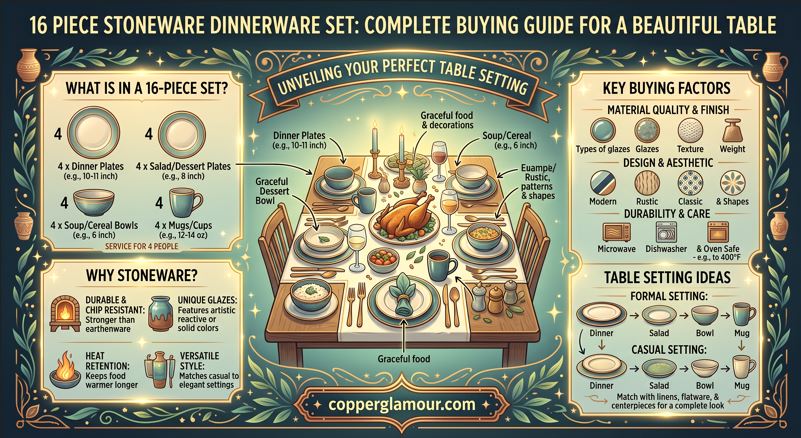
A 16 piece stoneware dinnerware set usually provides four coordinated place settings, commonly including four dinner plates, four smaller plates, four bowls, and four mugs. However, manufacturers use different configurations, so shoppers should check the exact contents before buying.
Stoneware is popular for everyday dining because it combines a substantial feel with a wide range of colors, glazes, textures, and shapes. Furthermore, a coordinated set makes it easy to build a polished table without buying every plate and bowl separately.
For homeowners who enjoy mixing materials, stoneware also pairs naturally with metal. Stainless steel flatware creates a clean contemporary finish, while copper introduces warmer color. Handcrafted drinkware, kitchenware, serving pieces, and home accessories from Copper Glamour can provide that additional metallic contrast.
What Is a 16 Piece Stoneware Dinnerware Set?
A 16 piece stoneware dinnerware set is a collection of ceramic tableware made primarily from stoneware and sold as a coordinated group.
A typical set may contain:
- 4 dinner plates
- 4 salad or dessert plates
- 4 bowls
- 4 mugs
That arrangement creates four complete place settings.
However, not every manufacturer follows this format. For example, some modern collections replace mugs with additional bowls. Others include pasta bowls instead of conventional cereal bowls.
Therefore, the total number of pieces should not be your only buying consideration.
How Many People Does a 16 Piece Dinnerware Set Serve?
A 16 piece dinnerware set most commonly serves four people when it contains four pieces for each person.
This format works particularly well for couples, smaller families, apartments, and households that do not regularly host large groups.
However, people who entertain frequently may purchase two matching sets. As a result, they receive service for eight while maintaining a consistent table design.
Before ordering, look for the phrase service for four rather than assuming that every 16-piece collection follows the same configuration.
What Does 16 Pieces Dinnerware Mean?
The phrase 16 pieces dinnerware describes the total number of individual items in the package.
For example, one dinner plate counts as one piece. Likewise, one bowl, mug, or side plate counts individually.
Therefore, a set containing four dinner plates, four side plates, four bowls, and four mugs contains 16 pieces.
Still, piece count tells you little about size.
A large dinner plate and a small mug each count as one piece. Consequently, compare actual dimensions and capacities before deciding whether a set meets your needs.
What Is Stoneware?
Stoneware is a type of ceramic pottery traditionally fired at relatively high temperatures.
As a result, it develops a dense body suitable for many functional household products.
Manufacturers use stoneware for plates, bowls, mugs, serving dishes, baking pieces, and decorative ceramics.
Furthermore, stoneware accepts many different surface treatments. You can find smooth glossy finishes, earthy matte surfaces, speckled patterns, hand-finished appearances, and dramatic reactive glazes.
The Encyclopaedia Britannica guide to pottery provides additional background on ceramic materials and pottery traditions.
Why Choose Stoneware Dinnerware?
Stoneware offers an attractive balance between practicality and appearance.
First, it usually has a substantial feel. Consequently, a stoneware plate can create a different dining experience from very lightweight tableware.
Furthermore, stoneware works with many decorating styles.
White or cream pieces suit minimalist interiors. Meanwhile, black and charcoal dinnerware can create dramatic contemporary tables.
Blue, green, brown, terracotta, and other earthy colors work particularly well in rustic or natural interiors.
Additionally, handcrafted-looking glazes can make each place setting appear slightly different.
Reactive Glaze Stoneware
Reactive glaze has become particularly popular in modern dinnerware.
During firing, glaze ingredients react to heat and one another. Consequently, subtle differences in color, texture, and pattern can appear across individual pieces.
These variations are often intentional.
For example, one blue plate may have slightly darker edges than another plate from the same collection. Likewise, speckles and color gradients can differ.
Therefore, people who want every plate to look completely identical may prefer a more uniform glaze.
On the other hand, shoppers who enjoy handcrafted character may appreciate natural variation.
Stoneware vs Porcelain
Stoneware and porcelain are both ceramics, but they often create different visual and tactile experiences.
Stoneware commonly feels thicker and heavier. Additionally, manufacturers frequently use rustic or reactive finishes on it.
Porcelain can offer a thinner and more refined appearance. However, properly manufactured porcelain can still provide excellent strength.
Neither material is automatically superior.
Instead, consider appearance, weight, price, storage, care requirements, and how frequently you intend to use the dinnerware.
Stoneware vs Earthenware
Earthenware represents another major ceramic category.
It is generally fired at lower temperatures than stoneware and tends to have a more porous ceramic body before glazing.
Stoneware, meanwhile, is typically denser.
However, manufacturing methods and glazes vary considerably. Therefore, consumers should rely on the care and durability information supplied with a particular product rather than making purchasing decisions solely from the ceramic category.
Choosing the Right Dinner Plate Size
Plate size deserves more attention than many buyers give it.
Large plates provide generous room for food presentation. However, they can create storage problems.
Before buying a set, measure your kitchen cabinets.
Additionally, check your dishwasher if you use one. Oversized plates may interfere with spray arms or prevent racks from closing correctly.
Dining-table size matters too.
Large plates combined with glasses, flatware, napkins, serving bowls, and decorative pieces can quickly crowd a compact table.
Therefore, select dimensions that fit your actual dining space.
Don’t Ignore the Bowls
Bowls have become increasingly important in modern dinnerware.
Traditional deep bowls work well for cereal and soup. Meanwhile, wide shallow bowls can handle pasta, salads, rice dishes, grain bowls, curries, and one-dish meals.
Consequently, some households use bowls more frequently than smaller plates.
Check both diameter and capacity before buying.
A photograph can make a shallow bowl appear larger than it actually is. Therefore, measurements provide a much better basis for comparison.
Are Stoneware Plates Dishwasher Safe?
Many modern stoneware collections are dishwasher safe, but you should never assume that all stoneware has identical care requirements.
Glazes, decorations, metallic finishes, and manufacturing methods vary.
Therefore, follow the manufacturer’s instructions.
When using a dishwasher, arrange pieces carefully so they do not repeatedly strike one another. Furthermore, avoid overcrowding the racks.
Proper loading can reduce the risk of chips.
Can Stoneware Go in a Microwave?
Many contemporary stoneware products are marketed as microwave safe.
However, exceptions exist.
For example, decorative metallic details can make some products unsuitable for microwave use.
Additionally, certain handmade or specialty pieces may have specific restrictions.
Therefore, verify microwave compatibility before heating food.
A manufacturer’s microwave-safe statement is more reliable than assuming that all stoneware behaves the same way.
How to Style Stoneware With Metal
Ceramic and metal materials can complement one another beautifully.
For example, cream stoneware creates a soft backdrop for stainless steel flatware. Meanwhile, black stoneware can produce strong contrast against warmer metallic pieces.
Copper provides another interesting option.
Its warm reddish tones can contrast with white, cream, gray, green, blue, and black stoneware. Consequently, copper mugs, pitchers, trays, serving bowls, or decorative accessories can become visual highlights.
Explore handcrafted copper table and kitchen accessories from Copper Glamour when building a layered table setting.
What Is 18/10 Stainless Steel?
Dinnerware frequently sits beside stainless steel flatware, which is why shoppers often encounter the term 18/10 stainless steel.
The designation commonly refers to stainless steel containing approximately 18% chromium and 10% nickel.
Chromium plays an important role in stainless steel’s corrosion resistance. Meanwhile, nickel can further support corrosion resistance and contribute to the material’s appearance and characteristics.
For this reason, 18/10 stainless steel is commonly associated with flatware and various kitchen products.
The Encyclopaedia Britannica overview of stainless steel provides more background on stainless alloys and their composition.
18/10 Stainless Steel Definition
A simple 18/10 stainless steel definition is:
A stainless steel composition commonly described as containing approximately 18% chromium and 10% nickel.
However, the designation should not be confused with metal thickness.
For example, 18/10 stainless does not mean 18-gauge steel.
Likewise, the “10” does not describe a 10-gauge thickness.
Instead, the numbers relate to alloy composition in common consumer labeling.
This distinction matters when comparing flatware, cookware, and sheet metal.
What Does 1810 Stainless Steel Mean?
People searching for 1810 stainless steel usually mean 18/10 stainless steel.
Removing the slash can make the term confusing. Nevertheless, in kitchenware searches, 1810 commonly refers to the same 18/10 composition terminology.
This stainless material frequently appears in flatware because manufacturers value its appearance and corrosion resistance.
However, composition alone does not determine product quality.
Thickness, weight, finishing, manufacturing quality, and design also matter.
Is 18/10 Stainless Steel Good for Flatware?
18/10 stainless steel is commonly used for quality forks, spoons, knives, and serving utensils.
However, shoppers should evaluate more than the alloy description.
For example, a fork should feel comfortable and balanced in your hand. Edges should feel smooth. Furthermore, the finish should appear consistent.
Weight also affects the dining experience.
Some people prefer substantial flatware, while others want lighter utensils. Therefore, personal preference remains important.
What Is 18/10 Stainless Steel Cookware?
18 10 stainless steel cookware refers to cookware that uses stainless steel associated with the 18/10 composition designation in relevant parts of its construction.
However, cookware performance depends on far more than the stainless surface.
Stainless steel itself is not as thermally conductive as copper or aluminum. Therefore, cookware manufacturers often combine materials.
For example, a pan may use stainless steel on the cooking surface and exterior while placing aluminum between those layers.
Other designs can incorporate copper.
This layered construction helps manufacturers combine the characteristics of different metals.
Pot Stainless Steel 18/10 Construction
When evaluating a pot stainless steel 18/10 product, examine its entire construction.
First, check whether it uses a bonded base or fully clad body.
A bonded-base pot concentrates conductive material in the bottom. Meanwhile, fully clad cookware extends multiple layers through more of the vessel.
Neither design is automatically right for everyone.
A large stockpot, for example, may not require exactly the same heat distribution characteristics as a frying pan.
Therefore, match construction to cooking style rather than choosing from the 18/10 label alone.
18/10 Stainless Steel Pans
18 10 stainless steel pans can offer durable cooking surfaces when properly manufactured and used.
However, stainless cooking requires some technique.
Preheating the pan appropriately can help. Additionally, cooking with sufficient fat can reduce sticking for many foods.
Temperature control matters as well.
Extremely high heat is not necessary for every meal. In fact, moderate heat can often produce excellent results when using quality clad cookware.
Furthermore, allowing certain foods to develop a cooked surface before attempting to move them can help them release more naturally.
Copper and Stainless Steel Cookware
Copper and stainless steel can also appear together in cookware construction.
Copper conducts heat very effectively. Stainless steel, meanwhile, provides a durable cooking surface for many applications.
Consequently, some premium cookware combines copper with stainless steel to take advantage of characteristics from both materials.
The Royal Society of Chemistry’s copper overview highlights copper’s high thermal and electrical conductivity.
Beyond cookware construction, copper can also serve a decorative role. Its warm color can create an attractive contrast with stainless flatware and ceramic dinnerware.
What Is a 16 Slice Apple Cutter?
A 16 slice apple cutter is a kitchen tool designed to divide an apple into numerous narrow wedges.
Many designs use a circular arrangement of blades surrounding a central coring section.
When pushed downward over an apple, the tool separates the fruit while removing or isolating the core.
Creating 16 sections produces narrower wedges than a conventional eight-section cutter.
Consequently, these tools can work well for lunch boxes, snacks, fruit platters, and food preparation.
16 Slice Apple Slicer for Meal Preparation
A 16 slice apple slicer can save time when preparing multiple servings.
For example, families can quickly create uniform apple wedges for breakfast or school lunches.
Thin wedges may also be easier to arrange on serving boards and fruit platters.
However, these tools contain sharp blades.
Therefore, use them on a stable cutting surface and keep fingers away from the blade assembly. Additionally, follow the manufacturer’s cleaning and safety instructions.
Apple Thin Slicer vs Apple Cutter
An apple thin slicer does not always mean the same thing as a wedge cutter.
Some products divide an apple vertically into wedges. Others produce thin flat slices.
For baking, flat slices may provide better results because uniform pieces can cook more evenly.
Meanwhile, wedge cutters are convenient for snacks.
Therefore, choose the tool according to the shape you actually need rather than the number of blades alone.
Building a Coordinated Kitchen
A well-designed kitchen does not require every object to come from the same collection.
Instead, repeating materials and colors can create visual consistency.
For example, stoneware dinnerware might establish the primary color palette. Stainless steel flatware and cookware can then introduce cooler metallic finishes.
Finally, copper can provide warmth.
Copper pitchers, mugs, serving bowls, trays, or decorative accessories can act as accent pieces. As a result, the kitchen can feel coordinated without appearing overly matched.
For additional copper-focused table and kitchen ideas, explore Copper Glamour.
How to Care for Stoneware Dinnerware
Good care can help stoneware maintain its appearance.
First, avoid sudden temperature changes unless the manufacturer specifically states that the pieces can handle them.
For example, moving a very cold ceramic dish directly into intense heat may create thermal stress.
Additionally, stack dinnerware carefully. Protective separators can help prevent rubbing between decorative pieces during storage.
Check for chips regularly as well.
Finally, follow the manufacturer’s instructions for dishwashers, microwaves, ovens, and cleaning products.
How Many Dinnerware Sets Should You Own?
A four-person household could theoretically use one 16-piece collection. However, owning only four of each item leaves little flexibility when pieces are dirty, damaged, or needed for guests.
Therefore, households that entertain regularly may prefer service for eight or more.
One option is purchasing two identical 16-piece sets.
Alternatively, you can intentionally mix compatible collections. For example, combining complementary neutral stoneware colors can create a relaxed modern appearance while making future replacements easier.
What to Check Before Buying
Look beyond the product photograph.
Confirm how many place settings the collection provides. Next, check the diameter of every plate and the capacity of each bowl and mug.
Furthermore, review microwave and dishwasher information.
Cabinet dimensions also matter. A beautiful oversized plate provides little value if it does not fit your storage space.
Finally, consider whether replacement pieces are available.
Being able to replace one broken plate can extend the useful life of an entire dinnerware collection.
Where to Buy a 16 Piece Stoneware Dinnerware Set in the USA
USA shoppers can find stoneware dinnerware through department stores, home-goods retailers, kitchen specialists, manufacturer websites, and established online marketplaces.
Before purchasing, compare material, dimensions, weight, glaze, care instructions, replacement availability, and actual place-setting configuration.
Additionally, think about the rest of your table.
Neutral stoneware can provide a versatile foundation for stainless steel flatware, glassware, textiles, and warm metal accents.
For handcrafted copper drinkware, kitchen accessories, serving pieces, and home décor that can complement a stoneware table, browse Copper Glamour.
Frequently Asked Questions
How many people does a 16 piece stoneware dinnerware set serve?
Most traditional 16-piece collections serve four people, with four items per place setting. However, always verify the manufacturer’s configuration.
What comes in a 16 piece dinnerware set?
A common set includes four dinner plates, four smaller plates, four bowls, and four mugs. Some manufacturers use different combinations.
Is stoneware good for everyday dinnerware?
Stoneware can work well for everyday dining. However, durability and care requirements depend on the individual product, glaze, firing process, and manufacturer’s instructions.
What does 18/10 stainless steel mean?
It commonly describes stainless steel containing approximately 18% chromium and 10% nickel. The designation relates to alloy composition rather than sheet-metal gauge.
Is 1810 stainless steel the same as 18/10 stainless steel?
In consumer kitchenware searches, “1810 stainless steel” commonly refers to 18/10 stainless steel. The slash simply makes the composition designation clearer.
Are 18/10 stainless steel pans good?
18/10 stainless steel can provide a durable cooking surface, but overall pan performance also depends on construction, conductive layers, thickness, shape, and manufacturing quality.
What is a 16 slice apple slicer?
It is a kitchen tool designed to divide an apple into multiple narrow wedges, often while separating the core.
Can copper work with stoneware and stainless steel?
Yes. Copper provides warm metallic color that can contrast effectively with ceramic stoneware and cooler stainless steel surfaces.
Final Thoughts
A 16 piece stoneware dinnerware set can provide an attractive and practical foundation for everyday dining. Most sets offer four place settings, although buyers should always verify the exact combination of plates, bowls, and mugs.
Furthermore, consider how dinnerware works with the rest of your kitchen. 18/10 stainless steel flatware can create a clean contemporary contrast, while well-designed stainless cookware adds practical durability. Small tools such as a 16 slice apple cutter or apple thin slicer can also make everyday food preparation easier.
Finally, mixing materials can create a more distinctive home. Stoneware adds texture, stainless steel introduces a cooler modern finish, and copper contributes warmth. Explore handcrafted kitchenware, drinkware, serving pieces, jewelry, and decorative accents from Copper Glamour to complete the look.