14 Inch Stainless Steel Skillet With Lid: Complete Buying and Cooking Guide
A 14 inch stainless steel skillet with lid is a large-capacity frying pan designed for family meals, batch cooking, searing, sautéing, and recipes that need considerably more cooking surface than a standard skillet provides. The included lid also increases versatility because it allows you to cover food while simmering, braising, or retaining moisture.
However, size is only one consideration. A quality skillet should also offer balanced construction, secure handles, even heat distribution, a sufficiently large cooking surface, and compatibility with your stove.
For USA kitchens that combine practical cookware with timeless metallic details, Copper Glamour offers copper kitchenware, drinkware, serveware, jewelry, and decorative pieces that pair beautifully with stainless steel.
Why Choose a 14 Inch Stainless Steel Skillet With Lid?
The biggest advantage of a 14 inch stainless steel skillet with lid is cooking space.
A large skillet allows ingredients to spread across the cooking surface instead of becoming overcrowded. Consequently, meat and vegetables can brown more effectively because moisture has more opportunity to escape.
A 14-inch skillet can be useful for:
- Large family breakfasts
- Several chicken portions
- Steak and vegetables
- One-pan dinners
- Large quantities of sautéed vegetables
- Pasta dishes
- Shallow braising
- Batch cooking
Additionally, the lid makes the skillet suitable for recipes that begin with searing and finish with covered cooking.
Stainless Steel Fry Pan 14 Inch: How Large Is It?
A stainless steel fry pan 14 inches across is considerably larger than the 8-, 10-, and 12-inch pans commonly found in home kitchens.
However, the advertised diameter does not always equal the flat cooking surface. Manufacturers generally measure a frying pan across the upper rim. Because the sides slope inward, the actual flat base may be noticeably smaller.
Therefore, check both the top diameter and cooking-surface dimensions before purchasing.
Large pans also require adequate burner coverage. If the burner is much smaller than the skillet’s base, the center may receive significantly more heat than the outer areas.
Who Needs a 14-Inch Skillet?
Large households can benefit from the additional capacity. Likewise, people who regularly entertain guests may appreciate being able to cook several portions at once.
A large pan can also help meal-prep enthusiasts. Instead of sautéing vegetables in several small batches, you may be able to prepare considerably more at once.
On the other hand, a 14-inch skillet may be unnecessarily large for someone cooking one or two portions. In that situation, a 10- or 12-inch pan may be easier to heat, lift, clean, and store.
Therefore, choose according to your actual cooking habits rather than simply buying the largest option.
Why Stainless Steel Works Well for Frying Pans
Stainless steel offers durability, corrosion resistance, and a cooking surface suitable for many foods.
Furthermore, it performs especially well for browning. Proteins can develop a flavorful crust, while the browned residue remaining in the pan can become the foundation for a sauce.
Stainless steel also handles acidic foods better than some reactive bare metals.
According to Encyclopaedia Britannica’s stainless steel overview, stainless steels contain chromium, which contributes to their resistance to corrosion.
Understanding 16 Gauge Stainless Steel Thickness
Consumers researching cookware and other kitchen equipment frequently encounter 16 gauge stainless steel thickness.
Under a commonly used U.S. Manufacturers’ Standard Gauge convention for stainless steel sheet, 16 gauge measures approximately 0.0598 inches, or 1.52 mm.
Still, this figure needs context.
A cookware manufacturer may construct a pan from several bonded metal layers rather than one solid stainless steel sheet. For example, stainless steel may surround an aluminum or copper core.
Consequently, knowing that a particular stainless sheet is 16 gauge does not tell you everything about a finished skillet’s performance.
What Does Stainless Steel Gauge Mean?
Stainless steel gauge is a traditional way of describing sheet-metal thickness.
One important rule makes the system easier to understand: within the same gauge standard, a smaller gauge number generally indicates thicker sheet.
Therefore, 16-gauge stainless sheet is thicker than 18-gauge stainless sheet under the same applicable convention.
However, gauge values are not universal across every metal. A particular gauge number can correspond to different physical thicknesses depending on the material and standard.
For precise comparisons, actual measurements in millimeters or inches are usually clearer.
Stainless Sheet Metal Gauge Explained
A stainless sheet metal gauge helps manufacturers and fabricators communicate material thickness efficiently.
Nevertheless, consumers should avoid treating gauge numbers as a simple linear scale.
For example, the difference between two neighboring gauges is not necessarily a fixed number of millimeters. Moreover, you cannot safely apply a stainless steel gauge measurement to another metal without checking the appropriate chart.
For engineering or fabrication work, always confirm the exact specification required for the material.
The National Institute of Standards and Technology provides authoritative information about measurement science and standards in the United States.
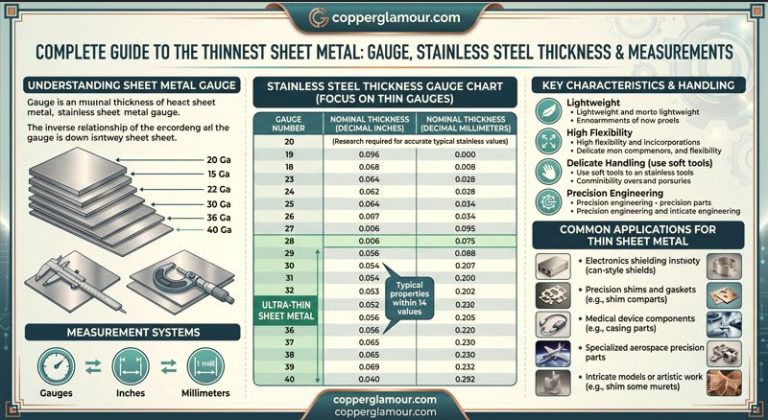
Stainless Steel Sheet Thickness Chart
A stainless steel sheet thickness chart converts gauge numbers into actual measurements.
Common approximate stainless sheet measurements under a widely used U.S. convention include:
- 22 gauge: 0.0299 inches, about 0.76 mm
- 20 gauge: 0.0359 inches, about 0.91 mm
- 18 gauge: 0.0478 inches, about 1.21 mm
- 16 gauge: 0.0598 inches, about 1.52 mm
- 14 gauge: 0.0747 inches, about 1.90 mm
- 12 gauge: 0.1046 inches, about 2.66 mm
- 10 gauge: 0.1406 inches, about 3.57 mm
Therefore, the material becomes thicker as the gauge number decreases in this system.
These measurements are useful reference points. However, always confirm the applicable material standard before using them for fabrication or engineering calculations.
Stainless Steel Sheet Thickness vs Cookware Thickness
Stainless steel sheet thickness can influence strength, weight, and heat behavior. However, cookware construction involves more than a single measurement.
A pan may contain several layers. For example, one common design sandwiches a heat-conductive aluminum core between stainless steel surfaces.
Other premium cookware may incorporate copper.
Therefore, two skillets with identical overall thicknesses can perform differently if their internal materials and construction differ.
Manufacturing quality also matters. Handle attachment, pan geometry, base flatness, and the quality of the bonded layers can all affect everyday performance.
What Is the Thinnest Sheet Metal?
There is no single measurement that defines the thinnest sheet metal.
Modern manufacturing techniques can produce extremely thin metal. Once material becomes sufficiently thin, manufacturers commonly classify it as foil rather than conventional sheet.
For cookware, however, extremely thin construction is not automatically desirable.
A very thin skillet can heat rapidly, but poor construction may create hot spots or make the pan more vulnerable to deformation. Meanwhile, extremely heavy cookware can become cumbersome.
Therefore, a well-designed skillet should balance heat response, heat distribution, durability, and manageable weight.
What Is 7ga Steel Thickness?
7ga steel thickness represents much heavier material than what most people associate with cookware walls.
Under a commonly referenced U.S. sheet-steel convention, 7-gauge steel measures approximately 0.1793 inches, or 4.55 mm.
However, 7 gauge should not be compared directly with stainless sheet measurements without confirming which gauge standard applies.
This level of thickness appears more frequently in heavy fabrication applications than ordinary cookware.
Gauge Stainless: Why Material Type Matters
People searching for gauge stainless measurements should always identify the material before using a conversion chart.
Gauge systems can be confusing because a gauge number does not function like an ordinary unit of measurement.
For example, 16 gauge does not simply mean 16 millimeters, 16 hundredths of an inch, or any other direct measurement.
Instead, the number corresponds to a defined thickness within a particular standard.
Consequently, specifying an actual measurement such as 1.52 mm often provides clearer information than simply saying 16 gauge.
Is Thicker Stainless Steel Better for a Skillet?
Not always.
A thicker pan can provide greater thermal mass and structural stability. However, additional thickness also increases weight and may change how quickly the cookware responds when you adjust the burner.
More importantly, stainless steel does not conduct heat as efficiently as aluminum or copper.
For this reason, many cookware manufacturers use layered construction. Aluminum can distribute heat effectively at a reasonable cost, while copper offers excellent thermal conductivity.
The Royal Society of Chemistry’s copper resource explains copper’s strong thermal and electrical conductivity.
Fully Clad vs Disc-Bottom Stainless Steel Skillets
Fully clad cookware typically contains bonded layers extending from the bottom through the sidewalls.
For example, a manufacturer may place aluminum between two stainless steel layers. As a result, conductive material extends beyond the base.
Disc-bottom cookware uses a different approach. In this design, manufacturers attach a conductive layer or disc primarily to the bottom.
Both approaches can produce useful cookware. Nevertheless, fully clad construction is particularly common in premium skillets because heat can spread through the pan walls as well as the base.
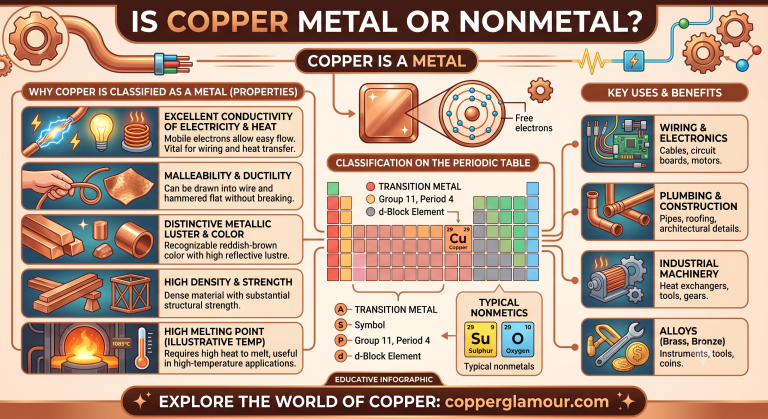
Why Copper and Stainless Steel Work Well Together
Copper and stainless steel offer complementary characteristics.
Stainless steel provides durability and a practical cooking surface. Meanwhile, copper transfers heat effectively.
Some premium cookware combines these metals in multi-layer construction. Additionally, copper kitchen accessories can create an attractive visual contrast with stainless steel appliances and cookware.
For example, a stainless steel kitchen can incorporate copper mugs, pitchers, bowls, trays, or decorative accessories without replacing existing cookware.
Explore copper kitchenware and handcrafted home accessories from Copper Glamour for ideas that combine traditional copper character with modern kitchen design.
How to Cook With a Large Stainless Steel Skillet
Good temperature control improves stainless steel cooking.
First, preheat the skillet gradually. Extremely high heat is unnecessary for many everyday recipes.
Next, add an appropriate cooking fat when needed. Once the pan reaches the desired temperature, arrange ingredients without overcrowding them.
Furthermore, give proteins time to develop a browned surface before moving them repeatedly. Properly browned food often releases more readily from stainless steel.
After cooking, you can use flavorful browned bits on the pan to prepare sauces.
Why the Lid Matters
A lid dramatically increases the usefulness of a large skillet.
Without a lid, the pan excels at searing, frying, sautéing, and reducing liquids. With the lid in place, you can retain more heat and moisture.
Consequently, covered cooking works particularly well for braises, vegetables, certain rice dishes, and one-pan meals.
Glass lids provide visibility, while stainless steel lids are typically durable and resistant to breakage. Each option has advantages, so personal preference and intended use should guide your decision.
Caring for a 14-Inch Stainless Steel Skillet
Allow the skillet to cool somewhat before washing it. Sudden extreme temperature changes can stress cookware.
For everyday cleaning, follow the manufacturer’s directions and use an appropriate non-abrasive cleaner or dish soap.
Additionally, soaking stubborn food residue in warm water can simplify cleaning. Drying the skillet afterward may also reduce visible water spots.
Most importantly, follow the manufacturer’s instructions because multi-layer construction, handles, and lids may have different care requirements.
Where to Buy a 14 Inch Stainless Steel Skillet With Lid in the USA
USA shoppers can find large stainless skillets through cookware manufacturers, kitchen specialty stores, department stores, restaurant-supply businesses, and established online retailers.
Before purchasing, verify the pan’s actual base diameter, total weight, handle construction, lid material, oven-temperature rating, induction compatibility, warranty, and cleaning instructions.
Meanwhile, shoppers creating a coordinated kitchen can pair stainless cookware with handcrafted copper kitchen and dining pieces. Browse Copper Glamour for copper drinkware, serveware, decorative accessories, and other artisan-crafted pieces.
Frequently Asked Questions
Is a 14 inch stainless steel skillet with lid too large for home cooking?
Not necessarily. It can be excellent for large families, entertaining, and batch cooking. However, make sure your burner, sink, dishwasher, and cabinets can accommodate its dimensions.
What can I cook in a 14-inch stainless steel fry pan?
You can use it for searing meat, sautéing vegetables, preparing large breakfasts, finishing pasta, cooking one-pan meals, and many other dishes.
What is 16 gauge stainless steel thickness?
Under a commonly used U.S. stainless sheet gauge convention, 16 gauge is approximately 0.0598 inches or 1.52 mm.
Does lower stainless steel gauge mean thicker material?
Generally, yes, within the same gauge standard. For example, 16 gauge is thicker than 18 gauge under the same stainless steel sheet convention.
Is stainless steel sheet thickness the same as cookware thickness?
Not necessarily. Multi-layer cookware can contain stainless steel plus aluminum, copper, or other materials. Therefore, total cookware thickness may differ substantially from the thickness of one stainless layer.
What does a stainless steel sheet thickness chart tell you?
It converts gauge numbers into physical measurements, usually inches and millimeters. However, always use a chart designed for the specific material you are measuring.
Is thicker stainless steel cookware always better?
No. Thickness is only one factor. Heat distribution, conductive core materials, manufacturing quality, balance, handles, and pan geometry also influence performance.
Final Thoughts
A 14 inch stainless steel skillet with lid offers substantial cooking space for large meals, batch preparation, entertaining, and versatile one-pan recipes. However, the best skillet is not simply the thickest or heaviest option. Instead, consider its overall construction, cooking-surface dimensions, conductive core, handle design, lid, weight, and compatibility with your stove.
Understanding stainless steel gauge, 16 gauge stainless steel thickness, and stainless steel sheet thickness also makes technical specifications easier to interpret. Most importantly, use the correct material-specific gauge chart rather than assuming every metal follows identical measurements.
Finally, stainless steel and copper can create an attractive combination in modern kitchens. Add warmth to stainless cookware and appliances with handcrafted kitchenware, drinkware, serving pieces, jewelry, and decorative accessories from Copper Glamour.